The Sierra Nevada’s First Test of the Games
The 1960 Winter Olympics were intended to showcase a new era of American winter sport—sleek facilities, international cooperation, and a bold vision for a small mountain valley transformed into a global stage. Yet nature delivered its own opening ceremony. A heavy snowstorm that began before dawn buried the region in fresh powder and immediately tested the young Olympic infrastructure.
State Highway 89, the narrow lifeline into Squaw Valley, became a seven‑mile chain of stalled cars stretching back to Tahoe City in one direction and two miles toward Truckee in the other. As Sgt. Frank Snyder of the California Highway Patrol observed, the bottleneck was unavoidable: the valley simply could not absorb vehicles as fast as they arrived. “Naturally many people will blame us for the traffic snarl,” he said, “but the problem is that the people in Squaw Valley are not parking the vehicles fast enough.”
The parking area—135 acres of compacted snow—was overwhelmed early. Navy Seabees worked nonstop with heavy rollers to pack down the 11 inches of new snow, but one of the access roads had to be closed, worsening the congestion.
A Valley Filling Faster Than Expected
Despite the storm, an estimated 3,000 spectators managed to reach the parking pad in time for the opening ceremonies inside the million‑dollar Ice Arena. Many others were still inching forward on the highway as the Olympic flame was lit.
Traffic from San Francisco and Sacramento was lighter than expected, but cars streamed steadily from Reno. Chains were mandatory over Donner Summit, and officials predicted that 3,000 cars and 200 buses would attempt the westward trip that night—an early sign of the unprecedented crowds the Games would draw.
Remarkably, accidents were few. A collision between a car and a school bus carrying 40 children ended without injuries, and only one serious mishap was reported: a driver whose vehicle skidded into the Truckee River roughly 32 miles from the valley.
A Snapshot of an Olympic Era
In retrospect, the traffic snarl of Day 1 has become part of the broader historical portrait of the 1960 Games. Squaw Valley was a bold experiment—an isolated mountain basin transformed almost overnight into an Olympic host. The challenges of that first morning reflected the scale of the undertaking: limited roads, unpredictable weather, and a global audience arriving faster than the valley could absorb.
Yet the chaos also underscored the spirit of the event. Spectators braved storms, long delays, and treacherous roads simply to witness the opening of America’s first Winter Olympics in 28 years. The Games would go on to be remembered for innovation, hospitality, and athletic achievement—but their beginning was marked by a reminder that the Sierra Nevada remained the valley’s most powerful force.
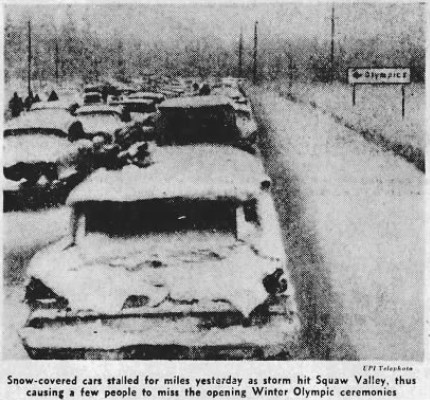
Courtesy of The San Francisco Chronicle February 19, 1960 via Newspapers.com
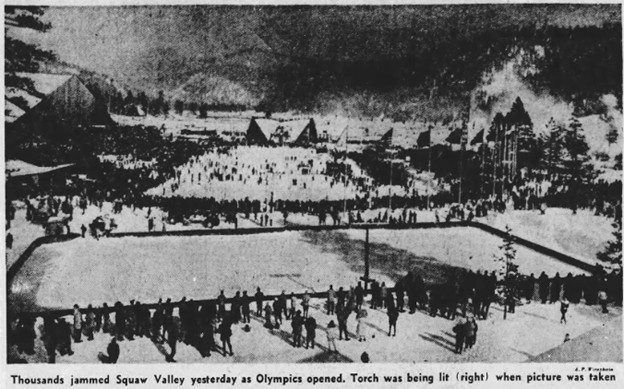
Courtesy of The San Francisco Chronicle February 19, 1960 via Newspapers.com
A Storm That Nearly Stopped the Show
The morning had brought eight inches of new snow, shifting from light flurries to driving sheets that reduced visibility to almost nothing. Roads into the valley were clogged, spectators were delayed, and even dignitaries struggled to reach Blyth Arena. Among those caught in the storm was Vice President Richard Nixon, whose late arrival forced a 15‑minute delay in the start of the ceremonies.
Those extra minutes proved decisive. At 1:45 p.m., as if on command, the snowfall ceased. The skies brightened, cameras adjusted their lenses, and the 7,500 spectators inside the arena—along with thousands more involved in the pageantry—watched the clouds lift in what many later described as a “mountain miracle.”
A Ceremony Saved by Sunlight
With the storm paused, the traditional parade of nations unfolded in full view. From Greece, the symbolic first entrant, to the United States as the final marching team, 30 delegations made their way across the ice as the long‑promised California sunshine broke through.
The sudden clearing also spared one of the ceremony’s most unusual features: the release of 2,000 pigeons, intended to serve as “doves of peace.” Earlier, their handlers had struggled to get them past security checkpoints in the storm, but once freed, the birds took flight into calm, cold air.
Fireworks burst into national colors, balloons rose above the arena, and the Olympic flame—carried down Papoose Peak by Andrea Mead Lawrence and then across the ice by speed skating champion Ken Henry—burned brightly in the Tower of Nations. Organizers, wary of the weather, had quietly lit the cauldron earlier in the day to ensure no mishap would mar the moment.
Only after the final spectators filed out did the storm return, resuming with heavy flakes as if the skies had been holding their breath.
A Symbol of the Games’ Tumultuous Journey
For many involved in planning the Squaw Valley Olympics, the sudden break in the weather felt emblematic of the entire four‑year effort. The Games had been marked by tight deadlines, last‑minute construction, and constant improvisation. Facilities were built at record pace, volunteers filled critical gaps, and state and federal agencies stepped in repeatedly to keep preparations on track.
The opening ceremony’s reprieve reinforced a sense that the event—despite doubts, criticism, and logistical strain—had been granted a moment of grace. Even the postponement of the men’s downhill event, delayed until Monday to allow crews to repack the snow, seemed minor compared to what might have been.
Human Moments Amid the Pageantry
The day also produced its share of small, memorable stories.
- High school band members from the Bay Area, unaccustomed to deep snow, marched through ankle‑high drifts while clutching frozen instruments—one tuba player discovered his horn had filled with snow.
- A truck carrying seat cushions for spectators never made it through the storm, leaving many to endure the cold on bare metal benches.
- The combined East and West German team debuted a newly designed flag, created to satisfy both sides under IOC rules.
- The American team’s bright red‑hooded parkas drew praise as one of the most striking uniforms of the parade.
Even the pigeons had their own adventure: their driver, stopped at a security checkpoint, reportedly convinced guards to let him through by asking, “How stupid do you think I’d be driving through this traffic in the snow with a load of pigeons?”
A Beginning That Set the Tone
As the athletes prepared to begin competition the next morning, the dramatic shift in weather became part of the lore of the 1960 Games. It was a reminder that these Olympics—held in a remote mountain valley transformed almost overnight—would be shaped as much by resilience and improvisation as by athletic achievement.
The storm had threatened to overshadow the moment. Instead, it framed one of the most memorable openings in Winter Olympic history, a day when Squaw Valley’s ambitions were briefly illuminated by a break in the clouds.
Heavy Snowfall Forces a Change
A deep layer of new snow—more than a foot on the upper slopes of Squaw Peak—made it impossible to prepare the two‑mile downhill course in time for its scheduled debut. As the original report noted, “the course must be packed hard for the racers with men and machinery used for the work”, but the storm rendered that effort futile.
Willy Schaeffler, the director of ski events, announced that the race would be moved to February 22, marking the first postponement of the 1960 Winter Olympics. The decision was not unexpected; planners had intentionally placed the downhill early in the schedule so that weather‑related delays could be absorbed without disrupting the entire Alpine program.
A Shift in the Opening Day Landscape
With the downhill pushed back, the first day of competition took on a different shape. The events still expected to proceed included:
- Men’s 30‑kilometer cross‑country race, provided athletes could reach the McKinney Creek course through continuing snowfall.
- Pairs figure skating, scheduled indoors and unaffected by the storm.
- Ice hockey, also able to proceed as planned.
The women’s downhill on KT‑22 remained on track for Saturday, as crews believed they could prepare that course in time.
Athletes React to the Delay
For many of the world’s top Alpine skiers, the postponement was more than a logistical inconvenience—it was an emotional setback. Downhill racers often build psychological momentum leading into their first run, and the sudden pause disrupted that rhythm.
Austria’s Karl Schranz, one of the leading contenders, expressed the sentiment shared by several European athletes: “I would have liked to start out with the downhill. I think I am strong in that event.”
The delay meant two additional days of waiting, recalibrating, and managing nerves—an early reminder that Olympic competition is shaped as much by conditions and circumstance as by training and talent.
Courtesy of The San Francisco Chronicle February 18, 1960 via Newspapers.com