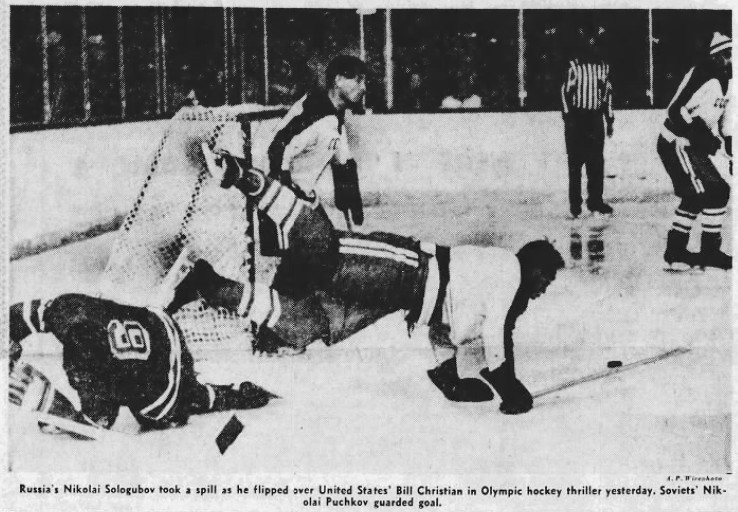
Courtesy of The San Francisco Chronicle February 28, 1960 via Newspapers.com
A Game That Redefined American Hockey
The matchup drew a packed house, with spectators stomping, shouting, and urging the U.S. team through every shift. The Soviets entered as defending Olympic champions and the dominant force in international hockey. The Americans, a team of college players and amateurs, were undefeated but still considered underdogs.
The game’s intensity was immediate. The United States struck first, only to see the Soviets respond with two quick goals. Yet the Americans refused to yield. Their resilience set the tone for a contest that grew more physical, more tactical, and more emotionally charged as the minutes ticked by.
The turning point came in the third period. With the score tied 2–2 and the arena vibrating with tension, the U.S. mounted a sustained offensive surge. At 5:01 remaining, Bill Christian—just 21 years old—fired home the rebound that would become one of the most celebrated goals in American hockey history. His brother Roger had started the play behind the Soviet net, and 19‑year‑old Tom Williams had forced the initial shot. It was a quintessential team goal, built on pressure, positioning, and persistence.
When the final horn sounded, with the Soviets attacking with six skaters and no goalie, the arena erupted. Players and officials poured onto the ice in jubilation, while the Soviet captain, Nikolai Sologubov, led his team to the blue line in dignified Olympic tradition. Moments later, both teams mingled to exchange congratulations—a gesture that underscored the spirit of the Games even amid fierce competition.
A Historic First for the United States
The victory marked the first time the United States had ever defeated the Soviet Union in championship hockey. It also placed the Americans one step away from their first Olympic hockey gold medal. A tie against Czechoslovakia the following morning would be enough to secure the title; even a loss could still leave the door open depending on Canada’s result against the Soviets.
The win also reshaped the tournament standings. Canada, which had nearly been eliminated earlier in the day, rallied from a 0–4 deficit to defeat Sweden 6–5, keeping the medal race alive. But the spotlight remained firmly on the Americans, whose improbable run had captured the imagination of spectators and athletes across Squaw Valley.
Heroes Across the Ice
While Bill Christian’s two goals made him the offensive star, the victory was built on a collective effort. Goaltender Jack McCartan, already a standout throughout the tournament, delivered another brilliant performance. His calm under pressure and ability to turn aside Soviet attacks kept the Americans within reach until their offense could break through.
The Cleary brothers, Bill and Bob, continued to anchor the forward lines with grit and intelligence. Roger Christian’s playmaking was essential on both U.S. goals in the final period. And the team’s discipline—remarkable in a game of such intensity—kept penalties to a minimum and prevented the Soviets from capitalizing on special‑teams opportunities.
Even the crowd played a role. The atmosphere inside Blyth Arena was unlike anything the region had seen before. From Governor Pat Brown to Olympic officials to everyday fans, the building shook with energy. The roar that followed the winning goal was described by witnesses as deafening.
A Contest That Reflected the Spirit of the Games
Beyond the score, the game embodied the ideals of the Olympics. The post‑game scene—American and Soviet players embracing, congratulating, and acknowledging one another—stood in stark contrast to the geopolitical tensions of the era. It was a reminder that sport could bridge divides, even in moments of fierce rivalry.
The match also showcased the evolution of international hockey. The Soviets played with precision and structure, their style often compared to chess. The Americans relied on speed, improvisation, and determination. The contrast made for a compelling contest and hinted at the global growth of the sport.
A Victory That Set the Stage for History
With one game remaining, the United States found itself on the threshold of an achievement that had once seemed impossible. The win over the Soviets did more than alter the standings—it transformed the perception of American hockey and set the stage for a final day that would determine whether this remarkable run would culminate in gold.
The drama of Day 10, the emotion on the ice, and the significance of the victory ensured that this game would be remembered as one of the defining moments of the 1960 Winter Olympics.
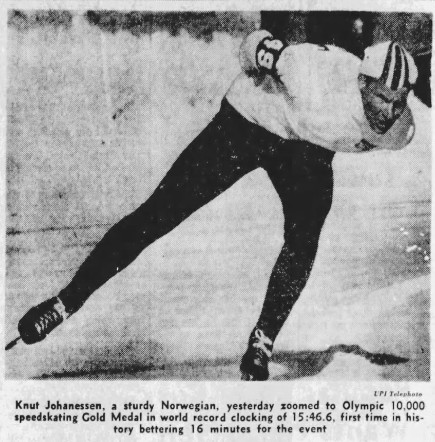
Courtesy of The San Francisco Chronicle February 28, 1960 via Newspapers.com
A World Record That Redefined the 10,000 Meters
Norway’s Knut Johannesen, a 26‑year‑old carpenter, produced one of the most astonishing feats of the Games when he shattered the world record in the 10,000‑meter speed skating event. His time of 15:46.6 broke the 16‑minute barrier for the first time in Olympic history—a milestone that drew an emotional announcement from the public‑address system: “The impossible has happened.”
The race became a cascade of record‑breaking performances:
- The world record fell five times during the event.
- Eight skaters broke the previous Olympic record.
- Ten national records were set.
Johannesen’s victory was more than a win; it was a recalibration of what was thought possible in long‑distance skating. His powerful, rhythmic stride carved deep into the ice, and by the final laps it was clear that the sport had entered a new era.
Russia’s Viktor Kosichkin, already a gold medalist earlier in the week, also broke the 16‑minute barrier to take silver. Sweden’s Kjell Bäckman, who had briefly held the world record earlier in the day, earned bronze.
For the United States, Ross Zucco of California delivered a personal triumph. His time of 16:37.6 shattered the American record, though it placed him tenth in a field that had collectively raised the standard of the sport. Teammate Arnold Uhrlass also broke the previous U.S. mark.
Finland’s Surprise Champion in the 50‑Kilometer Race
The day’s other major endurance event, the 50‑kilometer cross‑country race, produced a story as improbable as it was impressive. Finland’s Kalevi Hämäläinen, a 27‑year‑old forester, did not even know he was entered in the race until the night before. Yet he skied with remarkable strength and composure, winning in 2:59:06, just 21 seconds ahead of teammate and 1956 Olympic champion Veikko Hakulinen.
Sweden’s Rolf Rämgård finished third, completing a podium dominated by the Nordic nations that had long defined the sport.
The U.S. contingent struggled on the grueling 31‑mile course. Andrew Miller of Colorado placed 17th, with the remaining Americans finishing deep in the field. The results reflected the gap between the European endurance tradition and the still‑developing American program.
Shifts in the Team Standings
The combined impact of the day’s events reshaped the unofficial team standings:
- Soviet Union – 158.5 points
- Sweden – 69.5 points
- United States – 61 points
Sweden’s strong showing in the Nordic events allowed it to overtake the United States for second place. The Soviets, already far ahead, continued to build an insurmountable lead as the Games approached their final day.