Courtesy of The San Francisco Chronicle February 23, 1960 via Newspapers.com
Russia Pulls Away in the Medal Race
By the end of the day, the Soviet Union had effectively secured the unofficial team title. With 83½ points, nearly double second‑place Germany’s 48, the Soviets were dominating the endurance and skating events that formed the backbone of their winter sports program. And with several of their strongest disciplines still ahead, the outcome seemed all but decided.
Their latest gold came from Klara Guseva, who won the 1,000‑meter speed skating title in 1:34.1. Her victory, however, was shadowed by misfortune: Poland’s Elwira Seroczynska, matching Guseva’s blistering pace through the first two laps, fell on the final turn. As she slid across the ice, the crowd groaned; she rose quickly but skated to the finish in tears, her medal hopes gone.
For the United States, Jeanne Ashworth set a new national record (1:36.5) but finished eighth.
A German Mailman Becomes Nordic Champion
One of the day’s most compelling stories came from the Nordic combined. Georg Thoma, a stocky athlete from Germany’s Black Forest, delivered mail on skis during the winter—training woven into daily life. After leading the ski‑jumping portion the previous day, he surprised even himself by finishing fourth in the 15‑kilometer cross‑country race, securing the gold with 457.952 points.
Thoma called the result “a miracle,” admitting he had hoped only for sixth. His victory reflected the charm of the Nordic combined: a discipline where endurance, technique, and courage intersect in unpredictable ways.
The top American finisher was Alfred Vincelette of San Francisco, who placed 26th.
France Claims the Men’s Downhill
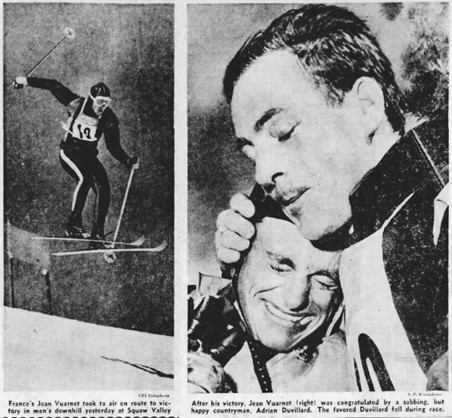
The glamour event of the day—the men’s downhill—belonged to Jean Vuarnet, a 27‑year‑old Frenchman with a movie‑star profile and nerves of steel. Vuarnet had finished third at Cortina in 1956, but his win at Squaw Valley represented a breakthrough four years in the making.
His time of 2:06.0 edged Germany’s Hanspeter Lanig by half a second. The victory was historic for another reason: Vuarnet raced on metal skis, the first Olympic gold ever won on such equipment. His coach explained that the unusual snow conditions—cold snow but warmer air—made the choice advantageous.
The French team celebrated with tears and embraces, a moment of national pride in a Games dominated by northern European nations.
The U.S. skiers struggled, with Dave Gorsuch finishing 14th after protesting an apparent disqualification. Roger Staub, fresh off his giant slalom gold, placed fifth. Austria, usually a powerhouse, faltered badly due to poor waxing.
Carol Heiss on the Brink of Gold
Amid the European sweep, Carol Heiss kept American hopes alive. After completing all five compulsory figures, she held a commanding lead with 837.8 points, more than 45 ahead of the Netherlands’ Sjoukje Dijkstra. With the free skate remaining—and Heiss considered even stronger in that phase—her long‑awaited gold seemed assured.
Her performance carried emotional weight. She had promised her mother, before her passing, that she would win Olympic gold. Each precise, elegant figure brought her closer to fulfilling that vow.
Barbara Ann Roles remained in third, giving the United States a strong presence on the podium.