Women Take Center Stage
The second full day of Olympic activity brought a rare convergence: women’s downhill skiing, women’s 500‑meter speed skating, and the six‑kilometer cross‑country race were all set to be decided within hours of one another. For a Games that had already battled storms, delays, and logistical strain, the packed schedule offered a welcome sense of momentum.
The United States and the Soviet Union entered the day as the dominant forces in women’s competition. American hopes rested heavily on the Alpine slopes, while the USSR—already a rising winter sports power—was expected to control the endurance and speed events.
American Alpine Contenders
In the women’s downhill, two U.S. skiers stood out as early favorites:
- Betsy Snite, the poised and technically sharp racer from Vermont
- Penny Pitou, the charismatic New Hampshire skier known for her smooth, fearless style
Both had emerged as leading figures in the American Alpine program, and their presence at the top of the odds reflected the United States’ growing investment in women’s skiing. Their duel with Europe’s traditional Alpine powers promised one of the most compelling storylines of the early Games.
Soviet Strength on the Snow and Ice
While the Americans looked to the mountains, the Soviet Union prepared to assert its dominance in the endurance disciplines.
In the six‑kilometer cross‑country race, the USSR fielded a formidable lineup, including Alevtina Kolchina, Marija Gusakova, Siiri Rantanen, and Liubov Baranova—athletes whose conditioning and technique had made the Soviet women the sport’s new standard-bearers.
The 500‑meter speed skating event was expected to follow a similar pattern. Tamara Rylova and Lydia Skoblikova, both rising stars in Soviet skating, were widely viewed as the athletes to beat. Their performances would help cement the USSR’s growing reputation as a winter sports powerhouse.
The Start of Figure Skating’s Most Anticipated Event
Day 2 also marked the beginning of the compulsory figures in women’s figure skating—the quiet, technical foundation of the sport. For American fans, this was the first step in what many hoped would be a coronation.
Carol Heiss, the reigning world champion from Ozone Park, New York, entered the Games as the overwhelming favorite. Her precision in the figures and her unmatched artistry in free skating made her one of the most recognizable athletes of the entire Olympics. The compulsory phase would set the stage for her expected triumph in the free skate the following Tuesday.
Nordic Combined Team Announced
Beyond the women’s events, the United States finalized its entries for the Nordic combined, a grueling two‑part contest blending cross‑country skiing and ski jumping. The American team included:
- Al Vincelette of San Francisco
- Ted Farwell of Montague City, Massachusetts
- John Cress of Tahoe City, California
- Craig Lussi of Lake Placid, New York
Their participation underscored the broadening scope of U.S. involvement in Nordic disciplines, long dominated by Scandinavia.
A Turning Point in the Games
Day 2 represented more than a busy schedule—it marked a symbolic shift in the 1960 Winter Olympics. After an opening day defined by storms, delays, and uncertainty, the focus finally returned to competition. And with women leading the program, the day highlighted the expanding role of female athletes in shaping the identity and drama of the modern Winter Games.
As the sun rose over Squaw Valley on February 20, the world prepared to watch a new generation of Olympians—American, Soviet, and beyond—write the next chapter of the Games.
Courtesy of The San Francisco Chronicle February 20, 1960 via Newspapers.com
Cross‑Country Dominance from Sweden
The first gold medal of the Games went to Sixten Jernberg, the wiry, relentless Swede whose reputation as one of the greatest Nordic skiers of his era only grew stronger at Squaw Valley. Jernberg covered the 30‑kilometer course in 1:51:03.9, leading from start to finish over the hard‑packed trails of McKinney Creek.
His victory was a commanding one, followed by fellow Swede Rolf Ramgard and the Soviet Union’s Nikolai Anikin, giving Scandinavia and the USSR an early foothold in the endurance events that traditionally defined Winter Olympic competition.
American skiers finished well back, but U.S. coach Sven Wiik praised Mack Miller’s 27th‑place finish as one of the strongest relative showings the country had ever produced in the event.
Canada’s Reign in Pairs Figure Skating
Inside Blyth Arena, the first figure‑skating medals of the Games were awarded, and the results reflected the global hierarchy of the sport.
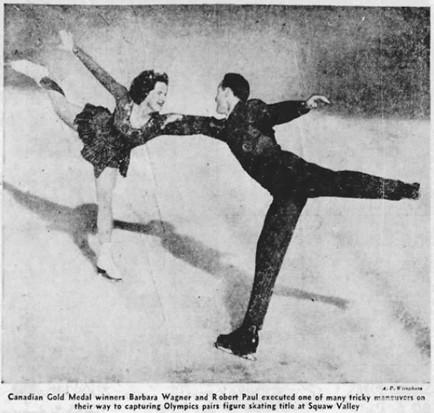
Canada’s celebrated pair Barbara Wagner and Bob Paul—already world champions—delivered a polished, confident performance to secure the gold. Their victory continued Canada’s long tradition of excellence in pairs skating.
The silver went to West Germany’s Marika Kilius and Hans Baumler, while the United States earned its first medal of the Games when Nancy and Ronald Ludington captured bronze. Their third‑place finish provided an early lift for the American delegation.
Two other U.S. teams, Maribel Owen & Dudley Richards and Ila & Ray Hadley, placed tenth and eleventh.
A Strong Start for U.S. Hockey
The outdoor rink brought its own drama as the U.S. men’s hockey team opened its Olympic campaign with a spirited 7–5 comeback victory over Czechoslovakia. The game unfolded in freezing temperatures before a small but enthusiastic crowd—many watching hockey for the first time.
Elsewhere on the ice:
- Canada defeated Sweden, 5–2, in a physical contest.
- The Soviet Union, defending Olympic champions, overwhelmed Germany 8–0 in a late‑night match that stretched past midnight.
These early results hinted at the fierce three‑way rivalry—U.S., Canada, USSR—that would come to define the 1960 hockey tournament.
A Modest Crowd for a Major Event
Despite the significance of the day’s competitions, attendance remained modest. Only about 1,000 spectators watched the cross‑country race, an event that routinely drew tens of thousands in Europe. Roughly 2,000 attended the figure‑skating finals. The sparse crowds raised early concerns about the financial outlook for the Squaw Valley Games, which had been built on ambitious expectations.
Early Medal Standings
Using the unofficial point system often cited at the time (10 points for first, then 5–4–3–2–1), the standings after Day 2 reflected the day’s results:
- Sweden – 17 points
- Canada – 13 points
- Soviet Union – 8 points
- Germany – 7 points
- United States – 4 points
- Finland – 1 point
These early rankings underscored the strength of the Nordic nations and the Soviet bloc in endurance sports, while Canada and the U.S. found their footing in skating and hockey.
Looking Ahead: A Packed Day for the Women
Day 3 promised one of the busiest schedules of the Games, with women’s events taking center stage:
- Compulsory figure‑skating figures
- 10‑kilometer cross‑country
- 500‑meter speed skating
- Women’s downhill skiing
- Three hockey games
The stage was set for a showcase of international talent—and for the United States and Soviet Union to renew their rivalry in multiple disciplines.
Giant Slalom Field Takes Shape
Late in the day, the major ski nations announced their entries for the upcoming giant slalom on KT‑22. The roster read like a who’s‑who of world Alpine skiing, including:
- France: Adrien Duvillard, Guy Périllat, François Bonlieu, Charles Bozon
- Switzerland: Roger Staub, Willy Forrer, Fredy Erpacher, Nando Pajarola
- Germany: Ludwig Leitner, Hans‑Peter Lanig, Willi Bogner, Fritz Wagnerberger
- Italy: Bruno Alberti, Paride Milianti, Italo Pedroncelli, Carlo Senoner
- United States: Tom Corcoran, Dave Gorsuch, Max Marolt, James Barrier
- Japan: Chiharu Igaya, Masayoshi Mitani, Osamu Tada, Takashi Takeda
- Austria: Anderl Molterer, Karl Schranz, Pepi Stiegler, Ernst Hinterseer
The depth of this field promised one of the most competitive Alpine events of the Games.
Courtesy of The San Francisco Chronicle February 20, 1960 via Newspapers.com
Courtesy of The San Francisco Chronicle February 20, 1960 via Newspapers.com from Art Rosenbaum’s column “Overheard”
The Olympics as Catalyst for a New Sierra
By the second day of competition, Squaw Valley had already proven it could host the world. Despite storms, delays, and frantic last‑minute construction, the Games were running, the athletes were competing, and the valley—once dismissed as a risky choice—had come alive. As Rosenbaum noted, complaints from foreign delegations had dwindled to “icicle drops,” and the once‑skeptical international press was beginning to acknowledge the achievement.
But even as the events unfolded, influential Californians were looking beyond the Games. The Olympics had reintroduced the Sierra Nevada to the world, and state officials believed the region’s future as a recreational destination was only beginning. The question was no longer whether Squaw Valley could host the Olympics—it was what the mountains would become afterward.
Visions for the “Other Side of the Mountain”
The most ambitious idea circulating during the Games involved the undeveloped slopes on the far side of KT‑22. From the top of the lift, one could look down into a pristine basin—raw, untouched, and full of potential. That area would soon be known as Alpine Valley, a project spearheaded by John McClintock Reily and John Milnor Reily, backed by prominent Bay Area investors.
Their plan envisioned:
- Four new ski lifts
- A day lodge
- Summer amenities including a nine‑hole golf course, swimming pools, and tennis courts
- A direct lift connection to KT‑22
The Reilys even purchased two of Walt Disney’s towering Olympic ice sculptures—16‑foot‑high figures that stood outside Blyth Arena—to serve as the symbolic entrance to the new resort.
The Olympic Games, in effect, were becoming the launching pad for a broader development boom.
Land, Opportunity, and the Post‑Olympic Landscape
Another intriguing subplot involved Alan Bartholomew, the original executive director of the Organizing Committee. During his tenure, he had acquired land adjacent to the proposed Alpine Valley site. With the Olympics nearing their conclusion, that property suddenly held enormous potential—either as part of the Reilys’ project or as the foundation for a new resort with sweeping views of Lake Tahoe.
Rosenbaum’s column hinted at a truth that would define the region for decades: the Olympics were not just a sporting event; they were a real‑estate catalyst. When the Games ended, the athletes would leave—but developers, investors, and visionaries would remain.
Human Moments Amid the Mountain Ambitions
True to the spirit of his column, Rosenbaum also captured the lighter side of Olympic life:
- Penny Pitou, America’s downhill star, charmed a public relations staffer into lending her his car—only for her to drive 50 yards and pick up her fiancé, Austrian skier Egon Zimmermann.
- The Games’ reliance on corporate sponsorships—“official” cars, “official” toothbrushes, “official” milkshakes—led to a humorous scramble as companies demanded equal recognition. Rosenbaum obliged, listing everything from Pepsi Cola (the “official pop”) to Longines (the “official Olympic watch”).
These anecdotes offered a glimpse of the Games’ personality: part athletic spectacle, part logistical circus, part cultural crossroads.
A Column That Captured a Turning Point
Rosenbaum’s Day 2 column stands today as a historical marker. It reflects:
- The pride Californians felt in pulling off an improbable Olympic project
- The early stirrings of the Tahoe region’s post‑Olympic expansion
- The blend of ambition, improvisation, and humor that defined the 1960 Games
While athletes chased medals on the snow and ice, others were already imagining the Sierra’s future—one shaped as much by lifts, lodges, and summer recreation as by Olympic glory.