Courtesy of The San Francisco Chronicle February 22, 1960 via Newspapers.com
A Record Crowd and a Defining Moment for Carol Heiss
An estimated 47,000 spectators filled the valley floor—an unprecedented turnout for American winter sports—and many came to watch the continuation of the women’s figure‑skating competition. Carol Heiss, already the dominant force in the compulsory figures, extended her lead with another near‑perfect performance.
Her total of 626.0 points placed her more than 45 points ahead of the Netherlands’ Sjoukje Dijkstra, a margin so commanding that only a major mishap in the free skate could threaten her path to gold. Heiss spoke openly about the personal meaning of her pursuit, recalling a promise made to her mother before her passing the previous year: she would win Olympic gold.
Behind her, Barbara Ann Roles of California held third place, reinforcing the United States’ strength in the discipline.
Switzerland Claims the Giant Slalom
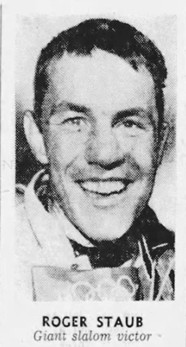
The day’s marquee Alpine event, the men’s giant slalom, delivered one of the most dramatic finishes of the Games. Roger Staub of Switzerland mastered the steep, fast KT‑22 course with a time of 1:48.3, navigating 56 gates over nearly 6,000 feet of vertical and horizontal drop.
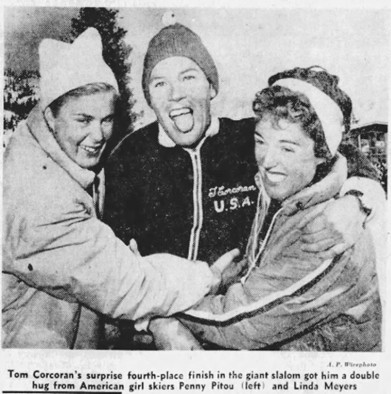
The race produced a historic American moment as well. Tommy Corcoran, competing in what he called his final major race at age 28, finished fourth, matching the best Olympic Alpine result ever achieved by a U.S. skier. His performance signaled the growing competitiveness of American men in a sport long dominated by Europeans.
Austrian stars Josef Stiegler and Ernst Hinterseer finished second and third, though Stiegler endured a moment of heartbreak when an initial timing error briefly suggested he had won.
A World Record on the Ice
In the 1,500‑meter women’s speed skating, the Soviet Union added another gold to its rising total. Lidija Skoblikova, a young skater from the Ural Mountains, unleashed a blistering final lap to finish in 2:25.2, breaking the world record. Her victory underscored the Soviet women’s growing dominance in the sport.
Poland’s Elwira Seroczynska took silver, while American skater Jeanne Ashworth—fresh off her bronze in the 500 meters—placed 11th but recorded the fastest time ever skated by an American woman in the event.
Sweden Triumphs in the Biathlon
The biathlon, still a relatively new Olympic event in 1960, produced one of the day’s most impressive performances. Klas Lestander of Sweden hit all 20 targets—a rare feat—while skiing a strong cross‑country leg to win the gold. His precision shooting separated him from the favored Soviet competitors, who finished third and fourth.
American biathlete John Burritt placed 14th despite four missed targets and a fall on the course, a respectable showing for a U.S. team still developing in the discipline.
Nordic Combined Takes Shape
The first half of the Nordic combined—the ski‑jumping portion—was won by Georg Thoma, a compact, powerful athlete from Germany’s Black Forest. His consistent jumps positioned him as the favorite heading into the next day’s 15‑kilometer cross‑country race.
The American contingent, led by John Cress of Tahoe City, finished in the upper 20s and low 30s, reflecting the nation’s ongoing efforts to build depth in Nordic events.
Courtesy of The San Francisco Chronicle February 22, 1960 via Newspapers.com
A Career Spent Chasing Legends
Throughout the late 1950s, Staub had been recognized as one of the world’s most technically gifted Alpine racers. Yet his career unfolded during an era dominated by Austria’s Toni Sailer, the three‑time Olympic champion whose brilliance defined the sport. At the 1958 world championships, Sailer won the downhill while Staub finished second; Sailer won the giant slalom while Staub placed third behind another Austrian, Josl Rieder.
Even after Sailer retired, Austria’s Karl Schranz appeared poised to inherit the Alpine throne, again relegating Staub to the role of perennial runner‑up. For years, Staub had been the skier who was always close—always in the mix, always respected, but never the one standing at the top of the podium.
At Squaw Valley, that narrative finally changed.
A Breakthrough on KT‑22
The giant slalom course on KT‑22 was steep, fast, and unforgiving—ideal terrain for a skier with Staub’s power and precision. Under bright Sierra Nevada sun and before the largest crowd yet assembled at the Games, he delivered a run that was both aggressive and controlled, finishing in 1:48.3.
The victory marked Switzerland’s first men’s Alpine gold since 1948, restoring the nation’s place among the sport’s elite. Surrounded by jubilant teammates, Staub described the course as “beautiful and fast,” noting that while the wind was strong at the start, conditions improved as he descended.
His relief was unmistakable. “I won at last,” he said—simple words that captured years of near‑misses and quiet determination.
A Skier of Many Talents
Staub’s win also highlighted the cosmopolitan nature of the 1960 Games. Fluent in German, French, and English, and the owner of a sporting‑goods shop in his hometown of Arosa, he embodied the blend of athleticism and professionalism that defined many European competitors of the era. His victory was not just a personal milestone but a moment of national pride for Switzerland, whose Alpine heritage had long shaped the sport.
A Turning Point in the Alpine Program
Staub’s triumph helped shift the competitive balance of the 1960 Olympics. Austria still claimed two podium positions—Josef Stiegler and Ernst Hinterseer finished second and third—but Switzerland had reclaimed a place at the top. For the United States, Tommy Corcoran’s fourth‑place finish provided a historic highlight, but Staub’s performance remained the centerpiece of the day.
His win also set the tone for the remaining Alpine events, where the rivalry among Switzerland, Austria, France, and the United States would continue to shape the narrative of the Games.
A Comfortable Win, but a Crucial One
The matchup against Australia was never expected to be close. The Australians were making their first Olympic hockey appearance, fielding a team with limited international experience. The Americans scored just over a minute into the game and never looked back, spreading goals across nearly the entire roster.
Even Jack Kirrane, the rugged defenseman and Boston fireman known more for his physical play than his scoring touch, found the net with an unassisted goal in the final period. The game itself lacked suspense, but it served its purpose: the U.S. secured its place among the six finalists who would battle for the Olympic title.
Those finalists were:
- Soviet Union (defending champions)
- Canada
- Sweden
- Germany
- Czechoslovakia
- United States
This group represented the strongest hockey nations of the era, and the Americans’ advancement placed them in the company of giants.
A Tournament About to Intensify
The final round‑robin promised a dramatic escalation in competition. The U.S. schedule underscored the challenge ahead:
- Germany on Monday
- Canada on Thursday
- Soviet Union on Saturday (the nationally televised “Hockey Game of the Week”)
These matchups would determine whether the Americans could contend for a medal—or even, as history would later show, something far greater.
The contrast between the quiet, sparsely attended U.S.–Australia game and the high‑stakes contests to come was striking. Only a small, chilled crowd gathered inside the arena for the blowout, but the upcoming games were expected to draw far more attention as the medal race tightened.
A Day of High Scores Across the Ice
Elsewhere in the tournament, the scoring was equally explosive:
- Sweden defeated Japan 19–0, one of the most lopsided results of the Games.
- Germany beat Finland 4–1, a more measured but important win for the Germans’ advancement.
These results reflected the wide disparity in international hockey development in 1960. Nations like Japan and Australia were still in the early stages of building competitive programs, while the European powers and North Americans were refining decades‑old traditions.