Courtesy of The San Francisco Chronicle February 24, 1960 via Newspapers.com
Carol Heiss Fulfills a Promise and Makes Olympic History
The atmosphere inside Blyth Arena was electric as 8,000 spectators watched Carol Heiss skate the free program that sealed her long‑anticipated gold medal. She had entered the day with a commanding lead from the compulsory figures, but her free skate transformed a statistical certainty into a moment of artistry.
Wearing a crimson costume trimmed in gold and white, Heiss performed with such control and musicality that the crowd erupted when one judge awarded her a 5.5 instead of a perfect 6.0. Her final weighted total—1,490.1 points—placed her far ahead of the Netherlands’ Sjoukje Dijkstra, with American Barbara Ann Roles securing bronze.
For Heiss, the victory carried deep personal meaning. Four years earlier, she had promised her mother, then gravely ill, that she would win Olympic gold. She came close in 1956, finishing second to Tenley Albright. At Squaw Valley, she fulfilled that vow. Her performance, set to music by Tchaikovsky, Delibes, and Rossini, became one of the most iconic moments of the 1960 Games.
European Nations Sweep the Remaining Golds
While Heiss delivered the United States its first gold, the rest of Day 6 belonged to Europe.
Women’s Giant Slalom
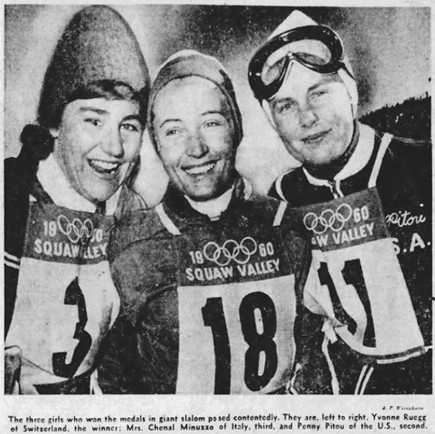
Switzerland’s Yvonne Rüegg won the women’s giant slalom in 1:39.9, edging American Penny Pitou by a heartbreaking one‑tenth of a second. It was Pitou’s second silver of the Games, both losses by razor‑thin margins. The U.S. had entered the women’s Alpine events with high expectations, but the day brought mixed results:
- Betsy Snite finished fourth
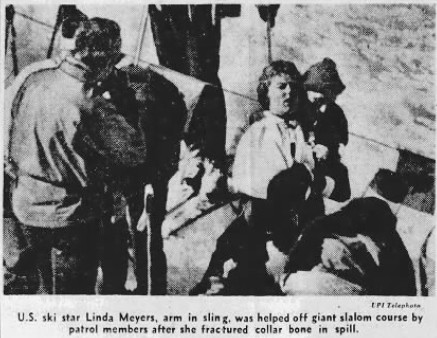
- Linda Meyers suffered a fractured collarbone after crashing into a gate
- Italy’s Giuliana Chenal‑Minuzzo earned bronze
Women’s 3,000‑Meter Speed Skating
Russia’s Lidia Skoblikova, already the 1,500‑meter champion, won her second gold with a time of 5:14.3, becoming the first athlete at the 1960 Games to win twice. Her teammate Valentina Stenina took silver, while Finland’s Eevi Huttunen earned bronze.
American Jeanne Ashworth, who had medaled earlier in the 500 meters, placed eighth.
Men’s 15‑Kilometer Cross‑Country
Norway’s Haakon Brusveen delivered one of the day’s biggest surprises by defeating Sweden’s legendary Sixten Jernberg. Brusveen’s time of 51:55.5 edged Jernberg by just over three seconds. Finland’s Veikko Hakulinen finished third.
The top American, Andrew Miller, placed 22nd.
Russia Tightens Its Grip on the Games
With victories piling up across multiple disciplines, the Soviet Union extended its commanding lead in the unofficial team standings:
- Russia – 104 points
- Germany – 49.5 points
- United States – 39 points
- Sweden – 36 points
The Soviets’ depth in speed skating, cross‑country skiing, and biathlon made them nearly unbeatable in the cumulative scoring system used at the time.
Courtesy of The San Francisco Chronicle February 24, 1960 via Newspapers.com
A Silver Medal That Felt Like a Loss
Penny Pitou, already carrying the weight of two near‑misses, entered the women’s giant slalom as one of the favorites. But she was racing under the strain of what she called “a cold to end all colds,” and the illness left her drained before she even reached the starting gate.
Despite the setback, Pitou delivered a courageous run—only to finish one‑tenth of a second behind Switzerland’s Yvonne Rüegg. It was her second silver medal of the Games, both decided by painfully small margins. For an athlete expected to contend for multiple golds, the result was bittersweet.
Yet her consistency placed her on the brink of winning the world Alpine combined title, a prestigious non‑Olympic honor awarded for cumulative results in downhill, slalom, and giant slalom. She needed only a top‑ten finish in the upcoming slalom to secure it.
Still, the emotional toll was clear. “Maybe I’m just getting used to winding up second,” she said, exhausted and congested. “I just can’t seem to reach out for that gold medal.”
A Day of Injuries and Setbacks
The giant slalom proved unforgiving for the rest of the American women as well.
Linda Meyers’ Crash
One of the United States’ strongest hopes, Linda Meyers, suffered the most serious setback of the day. After losing a pole early in her run, she approached a series of gates at high speed. A late turn caused her to straddle a gate and collide with a pole, striking her shoulder and face. Though she stood up on her own, Ski Patrol evacuated her by toboggan. Doctors later confirmed a fractured collarbone, ending her Olympic competition.
Betsy Snite’s Painful Fourth
Betsy Snite, still nursing bruised ribs from a fall earlier in the Games, skied bravely and finished only half a second behind the winner. But in a tightly packed field, that time placed her fourth—just outside medal range.
Beverly Anderson’s Determination
Beverly Anderson endured her own ordeal. After hitting a gate and losing a pole and her ski goggles—critical for protecting her contact lenses—she still managed to ski to the finish, placing 36th. Her gritty determination became one of the quiet stories of the day.
A Champion Shaped by Years of Dedication
Heiss made clear that her Olympic triumph did not begin with the 1956 Games or even with the start of the Squaw Valley competition. “I waited 14 years,” she said, tracing her path back to childhood lessons and the long partnership with her coach, Pierre Brunet, who had guided her from her earliest days on the ice.
Her victory also carried the weight of a promise. Before her mother’s death in 1956, Heiss vowed she would win Olympic gold. She came heartbreakingly close at Cortina, finishing second to Tenley Albright. At Squaw Valley, she fulfilled that promise with a performance that blended athletic mastery with emotional grace.
A Skater Who Connected With Her Audience
Unlike many competitors who approached the compulsory figures with rigid concentration, Heiss skated with a relaxed confidence. She smiled before stepping onto the ice and maintained that warmth throughout her routine. She explained that she always tried to meet the audience’s gaze: “I don’t want to give them the idea I’m just a robot going through the motions. I feel happy inside when I’m skating.”
This connection—eye contact, expression, presence—was part of what made her a transformative figure in women’s skating. She brought not only technical excellence but a performer’s instinct, elevating the sport’s artistic dimension.
A Career Defined by Excellence
By the time she reached Squaw Valley, Heiss had already built one of the most decorated résumés in figure‑skating history:
- Four‑time World Champion (1956–1959)
- Four‑time U.S. National Champion
- Two‑time North American Champion
- 1956 Olympic silver medalist
The gold medal she won on Day 6 became the crowning achievement of a career defined by consistency, discipline, and an unmistakable competitive fire.
A Moment of Joy and a Hint of Regret
Even in victory, Heiss acknowledged the sacrifices that had shaped her journey. She expressed regret that she had never been able to repay her parents for the financial strain of supporting her skating career. It was a reminder of the era’s realities: Olympic athletes, especially women, often trained without financial security, relying on family support and personal determination.
Yet her reflections were filled with gratitude and quiet pride. She described the day as “lovely,” with sunlight streaming across the ice—an ideal setting for the moment she had worked toward for more than a decade.
A Defining Story of the 1960 Games
Heiss’s gold medal became one of the signature achievements of the Squaw Valley Olympics. It stood in contrast to the struggles of the U.S. Alpine team and the overwhelming dominance of the Soviet Union in the medal standings. Her victory offered the United States a moment of celebration and a symbol of excellence rooted not in national power, but in personal perseverance.
Her story—of promise, loss, discipline, and joy—remains one of the most enduring narratives of the 1960 Winter Games.