U.S. Hurls Pioneer V Into Orbit Around the Sun
Thor‑Able Sends 90‑Pound Probe Toward Deep Space; Radio to Beam Back Solar Data
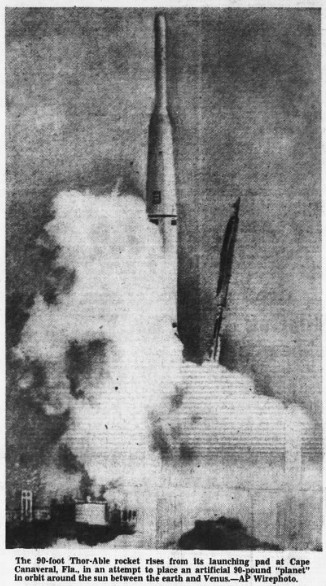
CAPE CANAVERAL, Fla., March 11 — The United States opened a bold new chapter in the exploration of space today with the successful launching of Pioneer V, a compact, 90‑pound scientific satellite now traveling in orbit around the sun. The achievement marks the nation’s most ambitious deep‑space venture to date and gives American scientists their first sustained opportunity to study the vast region between Earth and Venus.
The beachball‑sized probe was lifted aloft at 8 a.m. by a three‑stage Thor‑Able rocket whose 165,000 pounds of thrust pushed the payload beyond Earth’s gravitational pull. Three hours later, officials of the National Aeronautics and Space Administration announced that Pioneer V had achieved the velocity needed to enter a solar orbit—24,869 miles per hour, slightly above the required escape speed.
A New Frontier in Space Research
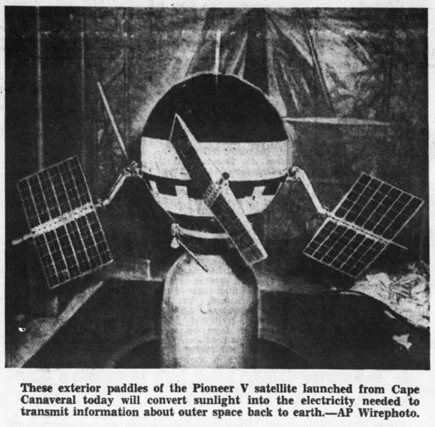
Pioneer V is expected to transmit information on radiation, magnetic fields, micrometeorites, and solar particles from distances up to 50 million miles. Scientists hope the probe will remain in communication for months, perhaps years, thanks to its powerful radio system and solar‑cell paddles, two of which were reported to have deployed properly.
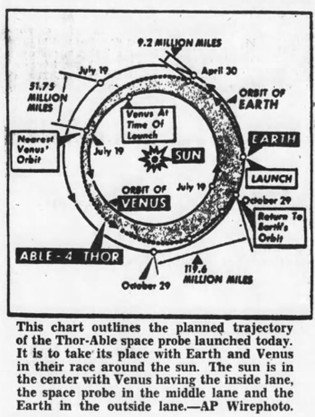
The probe will swing as close as 74.7 million miles to the sun—18 million miles nearer than Earth’s orbit—and will require 311 days to complete one revolution. Although planners had aimed for a slightly tighter orbit, NASA officials called the trajectory “well within tolerance.”
Radio Contact Established
Telemetry received four hours after launch indicated that Pioneer V was operating normally. A five‑watt transmitter began sending signals exactly on schedule, and a larger 150‑watt set—designed to reach Earth from 50 million miles—will activate once the probe is farther from home.
Dr. Adolph K. Thiel of Space Technology Laboratories reported that the payload separated from the rocket precisely on command. Dr. John Lindsay, head of NASA’s solar physics program, said all radio channels were functioning and described the launch as “very successful.”
Scientific and Strategic Importance
The mission carries both scientific and military significance. Pioneer V will gather data on the Van Allen radiation belts, the solar corona, and the little‑known region between Earth’s protective magnetic cavity and the undisturbed solar nebula. These findings will help determine the hazards future astronauts may face and improve understanding of how solar activity affects weather and communications on Earth.
Dr. Homer E. Newell of NASA noted that the probe’s measurements will be compared with those of Earth‑orbiting satellites to track how solar disturbances propagate through space.
The launch also comes at a critical moment in the space race. The Soviet Union surged ahead last year with two spectacular moon shots, while the United States suffered a setback in its own lunar attempt. Today’s success gives the U.S. a needed boost in the contest for scientific leadership.
Toward Venus and Beyond
Although Pioneer V will not approach Venus closely, its path lies within the planet’s orbital region, providing valuable information for future missions. NASA officials hinted that today’s launch may pave the way for an attempt to send a satellite around Venus when the planet reaches a favorable position next January.
Pioneer V joins two other solar‑orbiting satellites—Russia’s Mechta and America’s Pioneer IV—but will travel closer to the sun than either. Its long‑range radio system is the most powerful ever sent into space.
A Step Toward Measuring the Universe
One of the probe’s additional tasks is to refine the measurement of the astronomical unit, the 93‑million‑mile distance between Earth and the sun that serves as the yardstick for the solar system. By tracking Pioneer V’s position with great precision, scientists hope to reduce the current margin of error of 50,000 miles.
The launch, delayed 24 hours by fueling difficulties, proceeded flawlessly today. All three rocket stages fired within a second of their planned times, and the final velocity was within 120 feet per second of the target.
As Pioneer V speeds outward on its long arc around the sun, it carries with it the hopes of American science—and a clear signal that the United States intends to compete vigorously in the exploration of space.