DISCOVERER XI ROARS INTO POLAR ORBIT; U.S. TO TRY FIRST RECOVERY FROM SPACE
300‑Pound Capsule Set for Return Over North Pole
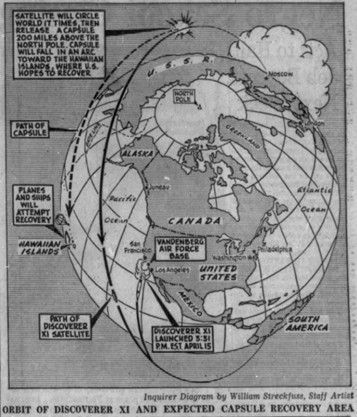
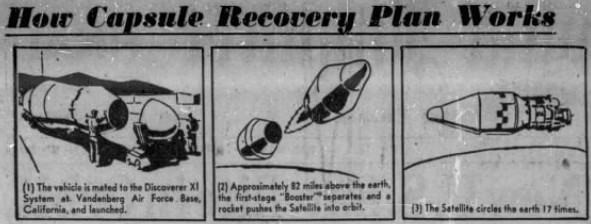
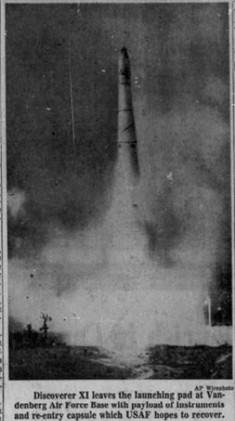
VANDENBERG AIR FORCE BASE, Calif., April 15 — The United States scored another bold advance in its rapidly expanding space program today with the successful launching of Discoverer XI, a polar‑orbiting satellite carrying a 300‑pound capsule that Air Force crews hope to recover when it is fired back to earth tomorrow.
The 17‑foot craft, gleaming in the midday sun, lifted from its pad at 12:31 P.M. Pacific Standard Time and climbed straight upward before arcing southward over the Pacific. Within two and a half hours, tracking stations confirmed that the satellite had achieved a true pole‑to‑pole orbit, circling the globe every 92.35 minutes at speeds approaching 18,000 miles an hour.
Planes Poised for Mid‑Air Snatch
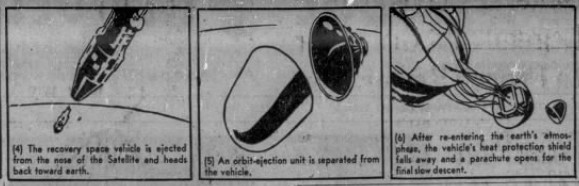
The capsule—packed with research instruments and guidance equipment—is scheduled for release Saturday afternoon, roughly 27 hours after launch. Air Force C‑119 “Flying Boxcar” transports, fitted with trapeze‑like catching gear, are waiting in Hawaii to attempt a mid‑air snare of the descending payload as it parachutes toward the Pacific from an altitude of about 200 miles over the North Pole.
Previous attempts to retrieve such capsules have failed, but project officers expressed high hopes that “Number Eleven” might break the jinx. “We think this could be the one,” an officer said as cheers broke out in the blockhouse when the satellite’s orbit was confirmed.
A First If Successful
Although the United States has recovered nose cones and animal capsules from ballistic flights, no nation has yet retrieved an object returning from orbit. Scientists emphasized that mastering this technique is essential to Project Mercury, the nation’s man‑in‑space effort.
The reentry vehicle, about the size of an orange crate, carries a heat shield developed by General Electric and similar to those proven on Thor and Atlas missile flights. Should the airborne recovery fail, Navy vessels will be stationed in the target zone to haul the floating capsule aboard.
Smoothest Launch Yet
Friday’s launch was described as “just about perfect.” The Thor first stage thundered off the pad with a roar that shook the press site 4,000 feet away. The rocket rose cleanly through the clear coastal sky, leaving only a thin white plume as it vanished into the blue.
Discoverer XI’s orbit ranges from a perigee of 109.5 miles to an apogee of 380 miles. Besides the capsule, the satellite carries 10 pounds of equipment to test tracking systems for the forthcoming Transit navigational satellite, including a Doppler radar device and six small lights visible only through optical instruments.
Toward More Advanced Systems
Air Force officials noted that the Discoverer series is paving the way for more sophisticated reconnaissance and early‑warning satellites, including the planned Midas and Samoa systems. Col. Harry L. Evans, assistant deputy commander for the Air Force space program, said the series has been “successful,” despite setbacks in the last two attempts—one failing to orbit, the other exploding shortly after launch.
Evans added that future Discoverer flights may employ an Atlas missile as the first stage and the more advanced Agena‑B second stage, which would allow controllers to alter a satellite’s course while in orbit.
Eyes on Tomorrow’s Descent
For now, all attention is fixed on tomorrow’s recovery attempt. Each C‑119 will have up to ten chances to hook the descending parachute at about 40,000 feet. If the chute can be draped over the trapeze, the capsule will be winched aboard.
“We will have to catch at least one capsule before we send any animals again into orbit,” Evans remarked, recalling that four mice aboard Discoverer IV were lost when that satellite failed to achieve orbit last year.
If Discoverer XI’s capsule is successfully retrieved, it will mark a major first for the United States—and a significant step forward in the contest for leadership in space.
Courtesy of The Philadelphia Inquirer April 16, 1960 via Newspapers.com