

Courtesy of 1960 Dallas Cowboys Media Guide
Preseason – Week 1
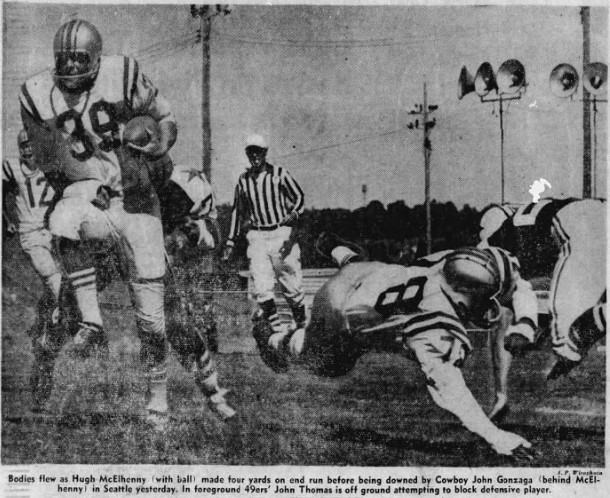
Cowboys Show Fight in First Outing, Fall to 49ers, 16–10
Late Rally Falls Short; Baker Interception Preserves San Francisco Win
SEATTLE, Aug. 6 — The Dallas Cowboys, making their first appearance as a National Football League club, showed determination and no shortage of spirit Saturday afternoon before falling to the San Francisco 49ers, 16–10, in an exhibition opener at the University of Washington stadium.
A crowd of 22,000 watched the new club battle back from a 9–0 halftime deficit and nearly steal the game in the closing minute. Only an interception by San Francisco defender Dave Baker at the five‑yard line halted a last‑ditch Cowboy drive that had carried from their own 37 to the 49er 27 in just under a minute.
Cowboys Rally Behind LeBaron
Eddie LeBaron, directing the Cowboys in the fourth quarter, sparked the late surge with a 56‑yard scoring pass to Frank Clarke. Moments later, after Gene Babb broke loose on a check‑off pass for 20 yards, Dallas appeared poised for a dramatic finish. Baker’s interception ended the threat, but the Cowboys had shown they could move the ball against veteran opposition.
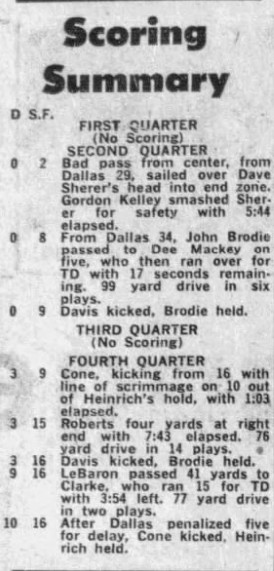
Earlier, Dallas had reached the San Francisco 16 behind Don Heinrich, only to settle for a 16‑yard field goal by Fred Cone.
Brodie Sharp in First Half
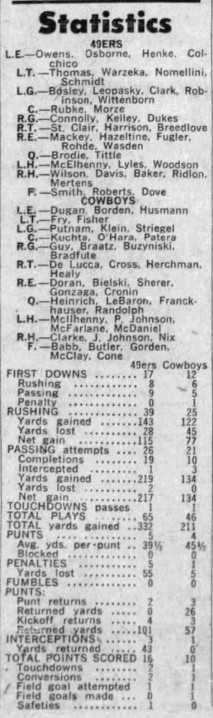
San Francisco controlled much of the afternoon, gaining 332 yards to Dallas’ 211, but the Cowboys’ defense kept the game close. John Brodie, starting for the 49ers, completed 11 of 14 passes for 133 yards and directed a second‑quarter touchdown drive. A safety by rookie Gordon Kelley made it 9–0 at halftime.
Y. A. Tittle played the second half for San Francisco and completed seven of 11 for 133 yards, leading a 76‑yard march capped by C. R. Roberts’ four‑yard run.
Dallas Defense Shows Promise
Despite the loss, the Cowboys displayed encouraging defensive play. Doyle Nix made a standout effort to down a punt at the San Francisco one‑yard line late in the second quarter, and the Dallas rush forced hurried throws throughout the afternoon.
Linebacker Dave Sherer was tackled in the end zone for a safety after a bad snap, but the Cowboys committed only one penalty in their first game, a five‑yard offside infraction.
Rookie Performances
Dallas rookies showed flashes of ability. Babb, formerly with San Francisco, contributed a key gain on the final drive. Don McIlhenny ran hard, though stopped twice for losses during a fourth‑quarter series. Clarke’s long touchdown reception was the Cowboys’ biggest play of the day.
49ers’ Depth Tells Late
San Francisco’s ball control — 65 plays to Dallas’ 46 — proved decisive. The 49ers’ rookies also impressed, particularly Kelley at linebacker and Dee Mackey at end, who scored on a 29‑yard pass from Brodie.
Roberts led all rushers with 61 yards on 16 carries.
Cowboys Look Ahead
For a club playing its first game, Dallas showed poise and resilience. LeBaron’s late rally, Heinrich’s steady direction, and several promising rookie efforts suggested that the Cowboys may develop quickly under coach Tom Landry.
The Cowboys return home to continue preparations for their inaugural regular season.
 |  |
Courtesy of The San Francisco Chronicle August 7, 1960 via Newspapers.com
Preseason – Week 2
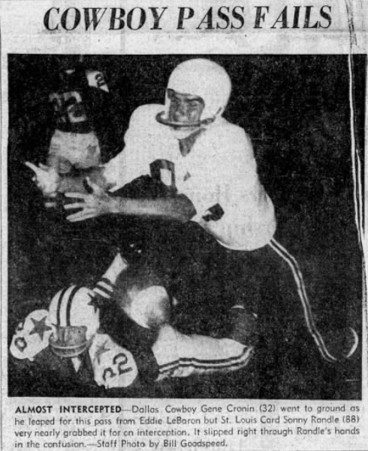
Cardinals Defeat Cowboys, 20–13, in San Antonio Exhibition
Quarterback Trio Guides St. Louis; Dallas Shows Improvement in Second Outing
SAN ANTONIO, Aug. 13 — The St. Louis Cardinals, making their first appearance under their new city banner, used three quarterbacks to good advantage Saturday night at Alamo Stadium and defeated the Dallas Cowboys, 20–13, in the second preseason game for the NFL’s newest club. A paid crowd of 14,057 watched the contest, the first professional football game of the season in San Antonio.
King Hill, John Roach, and M. C. Reynolds each directed St. Louis to a touchdown, giving the Cardinals a balanced offensive showing. Dallas relied on Eddie LeBaron in the first half and Don Heinrich in the second, but neither could sustain drives consistently against the Cardinals’ defense. Rookie Don Meredith suited up but did not play after appearing in the College All‑Star Game the previous night.
Early Breaks Produce Quick Scores
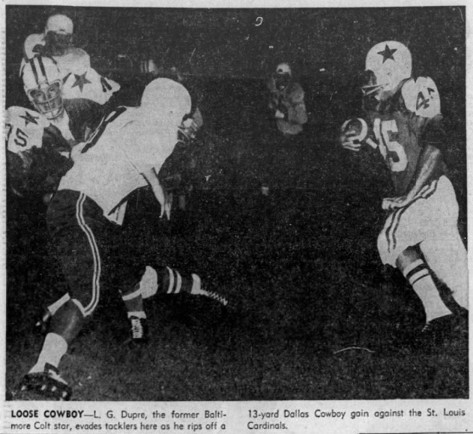
Both teams benefited from early miscues. After Dallas stopped a fourth‑down gamble at the St. Louis 47, LeBaron immediately hit Frank Clarke with a 38‑yard pass to the nine. L. G. Dupre carried three times, scoring around right end.
Dallas returned the favor moments later when a low snap on a punt attempt rolled back to Dave Sherer. St. Louis recovered at the Dallas 13, and Roach found Sonny Randle in the end zone on his third throw.
Trouble struck both clubs on the extra‑point attempts. Dallas failed to get the ball down cleanly, and St. Louis’ kick sailed wide.
Reynolds’ Late‑Half Drive
Reynolds engineered the drive that proved decisive, moving the Cardinals 48 yards in the final 51 seconds of the first half. Three straight sideline passes to Randle carried the ball to the one‑yard line, and Reynolds sneaked over for the score. Bobby Joe Conrad converted, giving St. Louis a 13–6 halftime lead.
Cardinals Extend Lead
Hill directed the Cardinals’ strongest march of the night early in the fourth quarter. John David Crow and Mel Hammack powered the ball to the Dallas 40, and Hill then connected with Conrad on a 35‑yard pass to the five. Hammack scored two plays later, and Conrad’s kick made it 20–6.
Cowboys Strike Back
Dallas answered quickly. Heinrich, working from his own 37, threw a long pass to rookie Gary Wisener, who caught it at the St. Louis 20 and raced into the end zone. Fred Cone’s conversion brought the Cowboys within seven.
Dallas threatened again late, but St. Louis controlled the ball with two sustained drives, one ending on a missed field goal and the other on downs at the Cowboy 13.
Statistics and Standouts
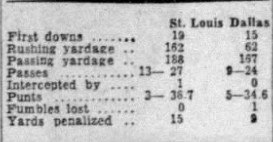
St. Louis held edges in first downs (19–15), total yards (350–229), rushing (162–62), and passing (188–167).
Roach completed three of four passes for 60 yards; Reynolds hit six of 13 for 57; Hill four of 10 for 71. LeBaron finished five of 13 for 77, and Heinrich four of 12 for 90.
Don McIlhenny led Dallas rushers with 39 yards on nine carries. Dupre added 25 on nine attempts, and Ollie McClay gained 35 on 11.
The Cowboys committed only one penalty, a five‑yard offside call, in their second outing as an NFL club.
Cowboys Continue Building
Though still seeking consistency, Dallas showed progress in its second preseason appearance. The club demonstrated improved defensive play, occasional offensive spark, and promising work from rookies such as Wisener.
The Cowboys return to training camp to prepare for their next exhibition test.
Courtesy of The San Antonio Express News August 14, 1960 via Newspapers.com
Regular Season – Week 1
Pittsburgh Steelers 35, Dallas Cowboys 28
September 24th, 1960 – Cotton Bowl Stadium
The Pittsburgh Steelers outlasted the Dallas Cowboys, 35–28, in a wide‑open contest before an estimated 30,000 fans at the Cotton Bowl on September 24, 1960. The game featured nine touchdowns and a barrage of big passing plays, while also marking a record‑setting afternoon for Steelers quarterback Bobby Layne.
Dallas struck quickly behind veteran quarterback Eddie LeBaron. On the Cowboys’ third offensive play, LeBaron connected with Jim Doran on a 75‑yard touchdown pass. Later in the opening quarter, LeBaron added a seven‑yard scoring toss to Fred Dugan, giving Dallas a 14–0 advantage. Pittsburgh answered before the period ended when Layne found Preston Carpenter for a 28‑yard touchdown to cut the margin.
The Cowboys extended their lead in the second quarter on a five‑yard run by Don McIlhenny, but the Steelers continued to respond. Layne capped a 66‑yard drive with a six‑yard touchdown pass to Jimmy Orr, keeping Pittsburgh within reach at halftime.
Momentum swung early in the third quarter after Pittsburgh’s Dean Derby intercepted a Dallas pass at the Steeler 30. On the ensuing sequence, Layne handed off to Tom Tracy, who then threw a 70‑yard touchdown pass to Buddy Dial, a sudden strike that energized the Steelers. Dallas countered with another long touchdown connection from LeBaron to Doran, this one covering 54 yards, but Pittsburgh answered again when Layne hit Carpenter for a 49‑yard score.
In the fourth quarter, Pittsburgh produced another long touchdown pass—Layne to Tracy for 65 yards—to complete the Steelers’ five‑touchdown passing day and provide the winning margin. Dallas was left to rue four turnovers, compared with one for Pittsburgh, in a game where each possession carried outsized importance.
Layne’s performance broke the NFL passing mark previously held by Sammy Baugh. LeBaron also turned in a strong showing for Dallas, completing 15 of 28 passes for 345 yards and three touchdowns, repeatedly stretching the field with deep throws and quick strikes that kept the Cowboys close until the finish.
Regular Season – Week 2

Courtesy of Philadelphia Daily News October 1, 1960 via Newspapers.com
Philadelphia Eagles 27, Dallas Cowboys 25
Friday September 30, 1960 – Cotton Bowl Stadium
The Philadelphia Eagles edged the Dallas Cowboys, 27–25, in a closely contested National Football League game played September 30, 1960, before a Cotton Bowl crowd in Dallas. The outcome remained in doubt until the final moments, as both teams traded scores and turnovers throughout the evening.
Dallas opened the scoring in the first quarter on a 32‑yard field goal by Fred Cone. Philadelphia answered later in the period when Bobby Walston connected on a 21‑yard field goal to tie the game. Walston added another field goal early in the second quarter, giving the Eagles their first lead, before quarterback Norm Van Brocklin found Tommy McDonald on a 16‑yard touchdown pass to extend Philadelphia’s advantage to 13–3. Cone closed the half with a 45‑yard field goal, trimming the Eagles’ lead to seven points at intermission.
The Cowboys surged early in the third quarter when Eddie LeBaron hit Frank Clarke for a 75‑yard touchdown pass, though the point‑after attempt failed, leaving Philadelphia ahead 13–12. The Eagles regained momentum in the fourth quarter behind the running of Billy Ray Barnes, who scored on a 10‑yard run and later added a 23‑yard touchdown dash. Walston converted both extra points, pushing the Eagles’ lead to 27–18.
Dallas mounted a late rally. LeBaron scored on a one‑yard quarterback sneak, though the conversion again failed, and later threw a 27‑yard touchdown pass to Gene Babb. Cone’s extra point brought the Cowboys within two points, but Philadelphia held on to secure the victory.
The game was marked by defensive pressure and turnovers, with each team committing five. Eagles linebacker Chuck Webber intercepted three LeBaron passes and led the defense with four unassisted tackles and seven assists. Defensive back Bob Freeman added an interception and blocked two Dallas conversion attempts. LeBaron finished with five interceptions, while Van Brocklin threw three for Philadelphia.
Despite a subpar passing night, Van Brocklin received strong support from the Eagles’ ground game. Barnes rushed for 68 yards on 13 carries and accounted for the final two Philadelphia touchdowns, while Clarence Peaks added 79 yards on 15 attempts. The Eagles’ ability to capitalize on key defensive plays ultimately proved decisive in a tightly fought contest.
Regular Season – Week 3

Courtesy of Washington Daily News, October 10, 1960 via Newspapers.com
Washington Redskins 26, Dallas Cowboys 14
Sunday Oct 9, 1960 – Stadium: Griffith Stadium
The Washington Redskins earned their first victory in nearly a year on October 9, 1960, defeating the Dallas Cowboys 26–14 before 21,142 fans at Griffith Stadium. The win ended a 13‑game drought for Washington and marked the club’s strongest all‑around performance of the young season.
Washington opened the scoring in the first quarter when rookie Bob Khayat connected on a 15‑yard field goal following a 32‑yard interception return by linebacker Rod Breedlove. Dallas briefly moved in front early in the second period, as Eddie LeBaron found Frank Clarke for a 32‑yard touchdown pass, with Fred Cone adding the extra point to give the Cowboys a 7–3 lead.
The Redskins responded quickly. Quarterback Ralph Guglielmi, making his first appearance since injuring his knee in preseason, directed a steady drive capped by a seven‑yard touchdown pass to Dick James. Khayat later added a 29‑yard field goal, sending Washington into halftime with a 13–7 advantage.
Washington extended its lead in the third quarter on Khayat’s third field goal of the afternoon, a 38‑yarder that pushed the margin to 16–7. The rookie kicker added a fourth field goal early in the fourth quarter, this one from 10 yards, giving the Redskins a 19–7 cushion and tying a club record for field goals in a game.
Dallas briefly threatened to rally midway through the final period. After two short rushing attempts near the goal line, LeBaron connected with Dick Bielski on a one‑yard touchdown pass, narrowing the deficit to 19–14 following Cone’s conversion.
The Redskins answered with their most decisive march of the day. A 35‑yard leaping reception by rookie Sam Horner moved Washington deep into Dallas territory, and Johnny Olszewski finished the drive with a one‑yard scoring run behind strong blocking from guard Vince Promuto. Khayat’s extra point closed the scoring at 26–14.
Guglielmi completed 10 of 16 passes for 237 yards, the best performance of his professional career to that point. Washington’s ground game also proved effective, led by Don Bossler’s 71 yards on 15 carries and a 50‑yard screen‑pass run that set up the team’s first touchdown. Horner and Jim Podoley contributed key receptions that sustained multiple scoring drives.
LeBaron finished with 296 passing yards on 21 completions, but the Redskins defense limited Dallas to just 56 rushing yards and intercepted three of his passes while also recovering a fumble. The Cowboys’ two scoring drives covered 75 and 68 yards, but Washington’s defensive pressure prevented sustained momentum.
The victory provided Washington with a long‑awaited breakthrough, combining efficient offense, a record‑tying kicking performance, and a disciplined defensive effort to hand Dallas its third loss since joining the league.
Regular Season – Week 4

Courtesy of The Akron Beacon Journal, October 17, 1960 via Newspapers.com
Cleveland Browns 48, Dallas Cowboys 7
Sunday October 16, 1960, Stadium: Cotton Bowl
The Cleveland Browns overpowered the Dallas Cowboys 48–7 on October 16, 1960, at the Cotton Bowl, dominating all phases of play before a crowd of 28,500. Cleveland scored touchdowns in every quarter, capitalizing on six Dallas turnovers and repeatedly striking with long gains on offense and special teams.
Cleveland opened the scoring in the first quarter when Milt Plum connected with Bobby Mitchell on a 46‑yard touchdown pass, with Sam Baker adding the extra point. The Browns extended their lead in the second period behind a series of rapid strikes: Jim Brown powered in from five yards out, Mitchell broke loose on a 30‑yard scoring run, and Larry Stephens returned an interception 34 yards for another touchdown. Baker converted all three attempts, sending Cleveland into halftime with a commanding 28–0 advantage.
The Browns continued their surge immediately after the break. Mitchell returned the second‑half kickoff 90 yards for a touchdown, and later in the third quarter Plum found Gern Nagler on a six‑yard scoring pass, stretching the lead to 42–0. Cleveland added its final points early in the fourth quarter on a five‑yard run by Jamie Caleb, though the kick failed.
Dallas avoided a shutout late in the game when Don Heinrich connected with Billy Howton on a 12‑yard touchdown pass, with Fred Cone converting to bring the final score to 48–7.
Cleveland’s defense overwhelmed the Dallas quarterbacks—Eddie LeBaron, Heinrich, and Don Meredith—forcing turnovers that repeatedly set up short scoring opportunities. LeBaron was benched in the second quarter after a fumble and two interceptions contributed to three Browns touchdowns. Dallas’ only sustained offensive success came in the opening minutes, when the Cowboys picked up three first downs on the ground before the Cleveland front tightened.
The Browns’ offense and special teams proved equally difficult to contain. Though Cleveland totaled a modest 329 yards, the club repeatedly broke long plays, including Mitchell’s 46‑yard reception and his 90‑yard kickoff return. Cleveland also rushed for 200 yards, with Brown and Mitchell contributing despite limited playing time.
The victory was tempered by injuries to flanker Ray Renfro, who suffered a knee collapse on a screen pass, and tackle Dick Schafrath, who left the game with rib trouble. Both players’ availability for the upcoming rematch with Philadelphia remained uncertain.
For Dallas, the defeat marked its most lopsided loss of the season. Coach Tom Landry cited protection breakdowns and early Cleveland scores as decisive factors, noting that the Browns’ defensive pressure neutralized the Cowboys’ passing attack until the final minutes.
Regular Season – Week 5
St. Louis Cardinals 12, Dallas Cowboys 10
Sunday Oct 23, 1960 – Stadium: Busch Stadium (Sportsman’s Park)
The St. Louis Cardinals edged the Dallas Cowboys 12–10 on October 23, 1960, at Busch Stadium (Sportsman’s Park), capitalizing on a late turnover to hand Dallas its fifth straight defeat. A crowd of 23,128 saw a defensive struggle dominated by field position, miscues, and the powerful running of St. Louis halfback John David Crow.
Dallas opened the scoring in the first quarter when Fred Cone converted a 25‑yard field goal for a 3–0 lead. St. Louis answered early in the second period when quarterback Eddie LeBaron was tackled in the end zone by defensive lineman Chuck Tracey for a safety. The Cardinals then mounted their first sustained drive of the afternoon, capped by Crow’s nine‑yard touchdown run. Bobby Joe Conrad’s extra point put St. Louis ahead 9–3 at halftime.
Neither team generated much offense through the air—St. Louis completed only four of 22 passes for 80 yards—yet the Cardinals controlled the tempo behind Crow’s 143 rushing yards on 24 carries. Dallas struggled to move the ball, finishing with just nine first downs and 175 total yards.
The Cowboys finally broke through in the fourth quarter. LeBaron connected with L.G. Dupre on a 32‑yard pass to the St. Louis three‑yard line, and Dupre scored moments later on a three‑yard run. Cone’s conversion gave Dallas a 10–9 lead with just over six minutes remaining.
St. Louis regained possession on the ensuing kickoff, but a John Roach pass was intercepted by Tom Franckhauser at the Dallas 34, seemingly putting the Cowboys in position to run out the clock. On the next play, however, Dupre was hit hard by Frank Fuller and fumbled. Luke Owens recovered for the Cardinals, shifting momentum once more.
St. Louis methodically advanced into scoring range, and with 43 seconds left, Gerry Perry connected on an 18‑yard field goal—his third successful kick in five attempts on the season—to put the Cardinals ahead 12–10. Dallas was unable to mount a final drive.
The loss continued a pattern of narrow defeats for the Cowboys, who had previously fallen by seven points to Pittsburgh, two to Philadelphia, and twelve to Washington. Their only lopsided setback came the week before against Cleveland. Despite another competitive showing, turnovers again proved costly, and St. Louis capitalized on the final one to secure the victory.
Regular Season – Week 6

Courtesy of The Baltimore Sun, October 31, 1960 via Newspapers.com
Baltimore Colts 45, Dallas Cowboys 7
Sunday Oct 30, 1960 – Stadium: Cotton Bowl
The Baltimore Colts overpowered the Dallas Cowboys 45–7 on October 30, 1960, at the Cotton Bowl, dominating from the opening minutes and handing Dallas its sixth straight defeat. Before an announced crowd of 25,500, Baltimore controlled the game with explosive passing, a relentless defense, and a decisive advantage in field position and total yardage.
Baltimore struck quickly. On the Colts’ third play from scrimmage, Johnny Unitas found Raymond Berry behind the secondary for a 68‑yard touchdown, with Steve Myhra adding the extra point. Early in the second quarter, Unitas connected with Berry again—this time on a 52‑yard scoring play—to extend the lead to 14–0. After a Dallas interception, Myhra added a 26‑yard field goal, and the Colts continued to capitalize on turnovers. Unitas hit Berry for a third touchdown, a 70‑yard strike, and later found Lenny Moore on a 20‑yard scoring pass. Myhra converted all four first‑half touchdowns, sending Baltimore into halftime with a commanding 31–0 lead.
The Colts opened the third quarter with an 80‑yard march capped by Billy Pricer’s two‑yard touchdown run. Dallas responded with its lone scoring drive of the afternoon when Don Heinrich completed a five‑yard touchdown pass to Billy Howton, with Fred Cone adding the extra point to make it 38–7.
Baltimore added its final points in the fourth quarter after recovering a Dallas fumble. Reserve quarterback Ray Brown directed a short drive and connected with Jerry Richardson on a seven‑yard touchdown pass, closing the scoring at 45–7.
The statistical disparity reflected the lopsided result. Baltimore amassed 493 total yards and 23 first downs, while Dallas managed only 147 yards and nine first downs. Berry caught four passes for 195 yards and three touchdowns, while Unitas completed eight passes for 270 yards and four scores before giving way to Brown. The Colts also rushed for 217 yards, led by Pricer’s 55 yards on 14 carries.
Dallas struggled throughout the afternoon. The Cowboys completed just eight passes and threw four interceptions, part of a six‑turnover performance that repeatedly set up Baltimore scoring opportunities. Eddie LeBaron, Don Meredith, and Heinrich all saw action under heavy pressure from the Colts’ defensive front.
The game also featured a brief skirmish in the fourth quarter involving players from both teams, though order was quickly restored. For Baltimore, the victory marked its first road win of the season and moved the club into second place in the Western Division. For Dallas, the defeat underscored ongoing difficulties protecting the passer and sustaining drives against top‑tier opponents.
Regular Season – Week 7

Courtesy of The Los Angeles Times, November 7, 1960 via Newspapers.com
Los Angeles Rams 38, Dallas Cowboys 13
Sunday Nov 6, 1960 – Stadium: Cotton Bowl
Los Angeles defeated the Dallas Cowboys 38–13 on November 6, 1960, at the Cotton Bowl, using a series of long scoring plays and a dominant offensive performance to hand Dallas its seventh straight loss. A crowd of roughly 16,000—the smallest of the season for professional football in Dallas—watched the Rams accumulate 500 yards of total offense while capitalizing on four Cowboy turnovers.
Dallas opened the scoring midway through the first quarter when Fred Cone connected on a 32‑yard field goal. The lead was short‑lived. On Los Angeles’s next possession, quarterback Frank Ryan found Red Phillips behind the secondary for a 61‑yard touchdown strike, and Danny Villanueva’s extra point put the Rams ahead 7–3. A Dallas fumble moments later set up a nine‑yard Villanueva field goal, extending the margin to 10–3.
The Rams continued to pull away in the second quarter. Joe Marconi capped a short drive with a six‑yard touchdown run, and after Dallas answered with a 21‑yard scoring run by Walt Kowalczyk, Ryan directed another quick strike. Phillips caught his second touchdown of the afternoon on a five‑yard pass, pushing the lead to 24–10. Cone added a 41‑yard field goal as the half expired, trimming the deficit to 24–13.
Los Angeles seized control early in the third quarter. Marconi broke through the middle of the Dallas line on a draw play and raced 75 yards for a touchdown, widening the lead to 31–13. The Rams added their final points in the fourth quarter when Billy Wade connected with Carroll Dale on a 40‑yard touchdown pass.
Dallas struggled to sustain drives throughout the afternoon, finishing with just 225 total yards. Kowalczyk provided the Cowboys’ lone offensive highlight with 91 rushing yards on nine carries. Don Meredith, making his first start at quarterback, helped set up both Dallas scoring drives but also threw three interceptions.
The Rams, meanwhile, received contributions from multiple sources. Marconi rushed for 115 yards on nine carries, while Phillips caught two touchdown passes and set up another score with a long reception. Villanueva converted all five extra‑point attempts and added a field goal.
Despite committing 149 yards in penalties, Los Angeles controlled the game from the first quarter onward. Dallas’s early field goal and Kowalczyk’s touchdown run briefly kept the contest close, but the Rams’ big‑play offense and the Cowboys’ turnovers proved decisive in another difficult outing for the first‑year franchise.
Regular Season – Week 8

Courtesy of The Green Bay Press-Gazette, November 14, 1960 via Newspapers.com
Green Bay Packers 41, Dallas Cowboys 7
Sunday Nov 13, 1960 – Stadium: New City Stadium, Green Bay
The Green Bay Packers overpowered the Dallas Cowboys 41–7 on November 13, 1960, at New City Stadium, using a dominant rushing attack, timely defensive plays, and a steady performance from Paul Hornung to hand Dallas its eighth consecutive defeat. The Packers controlled the game from the opening series and built a 27–0 halftime lead before cruising through the final two quarters.
Green Bay opened the scoring in the first period when Jim Taylor broke through the middle for a 28‑yard touchdown run, with Hornung adding the extra point. Taylor struck again early in the second quarter, this time on a four‑yard plunge that capped a short drive. Moments later, linebacker Ray Nitschke intercepted an Eddie LeBaron pass and returned it 43 yards for a touchdown, extending the Packers’ lead to 21–0.
Hornung added to the total with a pair of 21‑yard field goals late in the second quarter, sending Green Bay into halftime ahead 27–0. The Packers continued their dominance early in the third period when Taylor scored his third touchdown of the afternoon on a 23‑yard run, pushing the margin to 34–0.
Green Bay’s final touchdown came in the fourth quarter on a four‑yard run by Hornung, who also converted his own kick. Dallas avoided a shutout in the closing minutes when Don Meredith directed a 71‑yard drive and connected with Walt Kowalczyk on a 14‑yard touchdown pass. Fred Cone added the extra point to bring the final score to 41–7.
Taylor led all rushers with 121 yards on 15 carries, while Hornung contributed 17 points and a touchdown, two field goals, and five extra‑point conversions. Nitschke intercepted two passes and delivered one of the game’s most memorable plays with his long scoring return.
Dallas struggled to sustain drives throughout the afternoon, committing five turnovers and failing to score until the final minutes. The Cowboys’ offense was repeatedly stalled by Green Bay’s pressure, and the Packers’ early scoring surge left little opportunity for a comeback.
The victory improved Green Bay’s record to 5–2 and kept the club within a half‑game of the Western Division lead. For Dallas, the defeat continued a difficult inaugural season marked by narrow losses early and increasingly lopsided results against the league’s top teams.
Regular Season – Week 9

Courtesy of The San Francisco Chronicle, November 21, 1960 via Newspapers.com
San Francisco 49ers 26, Dallas Cowboys 14
Sunday Nov 20, 1960 – Stadium: Cotton Bowl
The San Francisco 49ers capitalized on seven Dallas turnovers and a steady kicking performance from Tommy Davis to defeat the Cowboys 26–14 on November 20, 1960, at the Cotton Bowl. Only about 10,000 spectators braved a light rain to watch Dallas drop its ninth straight game, ensuring the first‑year club would finish winless at home.
San Francisco opened the scoring in the first quarter after Dave Baker intercepted an Eddie LeBaron pass near midfield. John Brodie’s scrambling set up field‑position deep in Dallas territory, and when the drive stalled, Davis connected on an 18‑yard field goal for a 3–0 lead.
Dallas responded early in the second quarter with its most efficient march of the afternoon. LeBaron completed passes of 26 and 11 yards to Fred Dugan, moving the Cowboys into scoring range. Don Meredith entered on the next play and hit Jim Doran for a 16‑yard touchdown, giving Dallas a 7–3 advantage.
The 49ers answered with a second Davis field goal, this one from 27 yards, after Brodie guided San Francisco from its own 48 to the Dallas 20. The 49ers threatened again late in the half, reaching the Dallas 12 on a 30‑yard Brodie run, but Don Bishop intercepted a pass to preserve the Cowboys’ 7–6 halftime lead.
A Dallas miscue to open the third quarter shifted momentum sharply. Jim Mooty fumbled the kickoff, and San Francisco recovered deep in Cowboys territory. Davis soon added his third field goal, a 16‑yard kick that put the 49ers ahead 9–7.
Dallas briefly reclaimed the lead early in the fourth quarter when LeBaron connected with Frank Clarke on a 76‑yard touchdown pass, giving the Cowboys a 14–9 edge. But San Francisco responded immediately with the game’s decisive drive. Brodie directed an 80‑yard march, highlighted by his own running—he finished as the game’s leading rusher with 65 yards on four attempts. C.R. Roberts capped the possession with a 20‑yard touchdown run on a draw play, putting the 49ers ahead 16–14.
San Francisco added two more scores as Dallas turnovers continued to mount. Davis kicked his fourth field goal of the day, a 22‑yarder, and J.D. Smith sealed the outcome with a 14‑yard touchdown run in the closing minutes.
The Cowboys’ alternating‑quarterback system—Meredith and LeBaron switching on each offensive play—did little to stabilize an offense undone by mistakes. San Francisco, meanwhile, improved to 4–4 with the victory, controlling the final period and leaving little doubt about the outcome once Roberts’ touchdown put the 49ers ahead for good.
Regular Season – Week 10

Courtesy of The Chicago Tribune, November 28, 1960 via Newspapers.com
Chicago Bears 17, Dallas Cowboys 7
Sunday Nov 27, 1960 – Stadium: Wrigley Field
The Chicago Bears capitalized on two fumbled punts and a strong ground attack to defeat the Dallas Cowboys 17–7 on November 27, 1960, at Wrigley Field. A crowd of 39,951 saw Dallas drop its tenth straight game, while Chicago moved back into contention in the Western Division race.
The Bears opened the scoring less than four minutes into the game. After Johnny Morris returned the opening kickoff to the Chicago 22, Willie Galimore broke loose for a 54‑yard run to the Dallas 24. Five plays later, Rick Casares powered into the end zone from five yards out, and John Aveni’s conversion made it 7–0.
Dallas mounted a promising drive midway through the second quarter, reaching the Chicago 10 on Don Heinrich’s passing, but Fred Cone’s field‑goal attempt was blocked. The Bears were forced to punt on the ensuing possession, but Jim Mooty mishandled the kick, and Pete Manning recovered for Chicago at the Dallas 15. After a penalty pushed the ball back to the 20, Ed Brown hit Morris on a flat pass, and the receiver raced untouched for a 20‑yard touchdown. Aveni’s extra point extended the lead to 14–0 at halftime.
The Cowboys narrowed the margin early in the third quarter. Starting from their own 20, Don McIlhenny and Jean Babb moved the ball to the 36. Heinrich then connected with McIlhenny on a screen pass, and the halfback weaved through the Bears’ secondary for a 64‑yard touchdown. Cone’s conversion brought Dallas within 14–7.
Dallas threatened again early in the fourth quarter, reaching the Chicago 36 on a Heinrich pass to Jim Doran, who finished with seven receptions for 81 yards. But the Bears defense stiffened, forcing a punt and ending the Cowboys’ final scoring opportunity.
Chicago sealed the victory minutes later. Brown’s punt bounced off Dallas defender Bill Butler, and Manning recovered at the Cowboys’ 13. The Bears were unable to reach the end zone but extended their lead to 17–7 on Aveni’s 20‑yard field goal with just over four minutes remaining.
The Bears controlled the game on the ground, rushing for 221 yards on 38 carries, led by Galimore’s 89 yards on 12 attempts. Heinrich threw for 202 yards for Dallas, but the Cowboys’ miscues on special teams proved decisive. Before the game, Casares was honored for surpassing Bronko Nagurski as the Bears’ all‑time leading rusher, achieving the milestone in his sixth NFL season.
Regular Season – Week 11

Courtesy of New York Daily News December 5, 1960 via Newspapers.com
Dallas Cowboys 31, New York Giants 31
Sunday Dec 4, 1960 – Stadium: Yankee Stadium
The New York Giants and Dallas Cowboys battled to a 31–31 tie on December 4, 1960, at Yankee Stadium, as Dallas erased multiple deficits to halt its season‑long losing streak. A crowd of 55,033 watched the Cowboys rally twice in the fourth quarter to earn their first non‑loss of the year after ten straight defeats.
New York opened the game with two quick touchdowns. George Shaw directed an efficient opening drive, completing a 10‑yard scoring pass to Mel Triplett. Moments later, after Sam Huff intercepted an Eddie LeBaron pass and returned it to the Dallas 23, Joe Morrison powered over from the one‑yard line to give the Giants a 14–0 lead less than seven minutes into the contest.
Dallas responded late in the first quarter after Triplett fumbled near midfield. The Cowboys drove 60 yards, with L.G. Dupre finishing the march on a five‑yard run to cut the margin to 14–7.
The Giants extended their lead early in the second period when Shaw found Kyle Rote for a 28‑yard touchdown pass, making it 21–7. Dallas answered quickly. LeBaron connected with Dupre on a 21‑yard scoring pass, and just before halftime Fred Cone added an 11‑yard field goal, trimming New York’s lead to 21–17 at the break.
The third quarter produced only a single score—a 26‑yard field goal by Pat Summerall that pushed the Giants ahead 24–17. Early in the fourth quarter, Dallas tied the game when LeBaron hit Dupre again, this time on a 23‑yard touchdown pass following a short Giants punt.
New York regained the lead midway through the final period. Reserve quarterback Lee Grosscup, replacing the struggling Shaw, completed a 26‑yard touchdown pass to Bob Schnelker, giving the Giants a 31–24 advantage.
But another New York turnover set up the Cowboys’ final rally. Morrison fumbled near midfield with just over four minutes remaining, and Dallas recovered. LeBaron completed a 32‑yard pass to Jim Doran to reach the nine‑yard line, and after a short loss, he found Billy Howton on an 11‑yard slant for the tying touchdown with 1:37 left.
The teams finished with nearly identical offensive totals—328 yards for Dallas and 327 for New York. LeBaron threw for all 267 of Dallas’s passing yards, while Dupre scored three touchdowns and Howton caught six passes for 78 yards. For the Giants, Ed Sutton led all rushers with 62 yards, and Schnelker caught five passes for 69 yards and a score.
The tie prevented Dallas from matching the modern NFL record of 11 consecutive losses and dropped the Giants into third place in the Eastern Division, ending their hopes of defending their conference title.
Regular Season – Week 12

Courtesy of Detroit Free Press December 12, 1960 via Newspapers.com
Detroit Lions 23, Dallas Cowboys 14
Sunday Dec 11, 1960 – Stadium: Detroit Briggs Stadium
The Detroit Lions defeated the Dallas Cowboys 23–14 on December 11, 1960, at Briggs Stadium, using a powerful rushing performance from Nick Pietrosante and an efficient passing display by Earl Morrall to hand Dallas its eleventh loss of the season. The result preserved Detroit’s slim hopes of remaining in the Western Conference race while ensuring the Cowboys would finish their inaugural year without a victory.
The Lions broke a scoreless game early in the second quarter when Pietrosante burst through the middle for a 43‑yard touchdown run, with Jim Martin adding the extra point. Minutes later, Detroit extended its lead to 9–0 when a high snap from center sailed over Eddie LeBaron’s head and out of the end zone for a safety. Pietrosante struck again shortly afterward, bolting 40 yards on a five‑play drive to give the Lions a 16–0 advantage.
Dallas answered late in the half with a determined 70‑yard march aided by two interference penalties and a holding call against Detroit. L.G. Dupre, who finished with 83 rushing yards, capped the drive with a one‑yard touchdown run, narrowing the deficit to 16–7 at halftime.
Detroit regained control in the third quarter following a Dupre fumble near midfield. The Lions moved 69 yards, helped by another interference call at the Dallas nine, and Morrall connected with rookie Gail Cogdill on a seven‑yard touchdown pass to extend the lead to 23–7. Morrall, making his first start of the season, completed 12 of 14 passes for 145 yards in 20‑degree conditions.
Dallas mounted one final scoring drive in the fourth quarter. LeBaron completed four passes and kept the march alive with an 11‑yard run on a fake punt. He then found Billy Howton for a 31‑yard touchdown pass, bringing the Cowboys within 23–14, but Detroit’s defense held firm the rest of the way.
Pietrosante led all rushers with 142 yards on 21 carries, becoming the second‑leading ground gainer in Lions history and moving within reach of Ace Gutowsky’s long‑standing club record. Detroit and Dallas each committed three turnovers, and both teams were heavily penalized—117 yards against the Cowboys and 86 against the Lions. The loss concluded Dallas’s winless debut season, the first time since 1944 that an NFL team finished without a victory. Detroit, meanwhile, carried its postseason hopes into the final week of the campaign.