Johnson Wins First World 600 in Wild, Wreck‑Filled Afternoon
Chattanooga Driver Takes Lead After Smith Retires; Only 24 of 60 Cars Finish
CHARLOTTE, N.C., June 19 — Joe Lee Johnson of Chattanooga steered his 1960 Chevrolet through a long afternoon of spinning cars, blown tires, and mechanical failures Sunday to win the first running of the World 600 at the new Charlotte Motor Speedway.
Johnson, driving for owner‑mechanic Paul McDuffie, completed the 400 laps at an average of 107.735 miles per hour and collected $27,330 from the $107,775 purse. An estimated 60,000 spectators watched a race that produced nearly everything but a fatality.
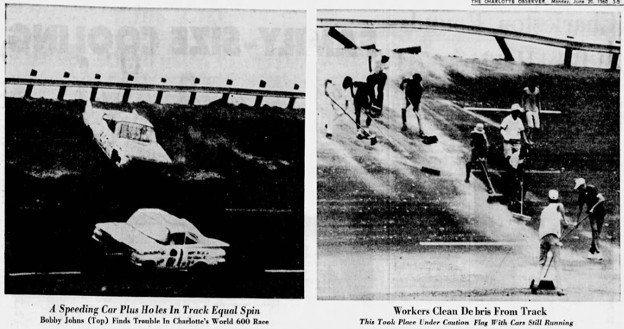
The early laps were marked by repeated mishaps. Fireball Roberts spun twice, Bunkie Blackburn three times, Johnny Allen’s car caught fire, and Junior Johnson tore down a section of fencing on the homestretch apron. At least ten cars spun on the front stretch alone as the track surface broke apart under the heat.
Johnson Emerges After Mid‑Race Attrition
Johnson was not a factor in the first half of the race. He appeared among the leaders only after the 240th lap, rising to fifth place. By lap 300 he had moved into second, still five laps behind Jack Smith’s fast‑running Pontiac.
Smith, who had led 198 laps and appeared headed for victory, was forced out when a hole developed in his fuel tank. With Smith gone, Johnson took the lead on lap 352 and was never challenged again.
He finished four laps ahead of runner‑up Johnny Beauchamp, also in a Chevrolet. Third, fourth, and fifth places went to Bobby Johns, Richard Petty, and Lee Petty, all in Plymouths.
Rounding out the top ten were Gerald Duke, Buck Baker, Rex White, Banjo Matthews, and Tiny Lund.
Only 24 of the 60 starters were still running at the finish.
Track Surface Causes Trouble
The 24‑degree turns deteriorated badly as the race progressed, with large holes forming in the asphalt. Flying stones shattered at least five windshields. The rough surface contributed to the slow winning time and to the high number of spins and mechanical failures.
Roberts, whose Pontiac was the fastest in the field, led the opening 70 laps before his first pit stop. He later spun into the fourth‑turn guard rail and retired around lap 200. Tom Pistone dropped out when his engine failed, Junior Johnson lost a wheel, and Curtis Turner blew his motor.
Six different drivers led at various points: Roberts for 114 laps, Pistone 14, Junior Johnson 5, Turner 21, Smith 198, and Joe Lee Johnson 43. Only Johnson was running at the finish.
McDuffie Finally Strikes Gold
The victory was especially satisfying for McDuffie, whose cars suffered repeated misfortune last season. Once part of a successful partnership with Roberts, McDuffie had not enjoyed major success since their split. On Sunday, Roberts watched from the sidelines while McDuffie’s Chevrolet took the checkered flag.
The winning car was the same machine driven by Bob Welborn in the Darlington 300, though Welborn had switched to a Ford for this event.
Speedway Officials Pleased Despite Problems
Track owner B. L. Marchbanks and his son Bonnie expressed confidence that the new speedway would become a major stop on the NASCAR circuit. Despite the heat and surface issues, the facility drew praise from drivers and officials.
The next major event for the competitors will be the World 600’s sister race, the World 600 at Charlotte, with a purse of $110,000.
Johnson Says He “Raced Car and Track,” Not Drivers
World 600 Winner Credits Steady Pace, Pit Crew, and McDuffie’s Setup
CHARLOTTE, N.C., June 19 — Joe Lee Johnson, the quiet mechanic‑driver from Chattanooga who captured Sunday’s inaugural World 600, stood in Victory Lane afterward with a towel in his hand, a blanket of roses on his Chevrolet, and a smile that came slowly but sincerely.
“No, I didn’t race anybody,” Johnson said as photographers crowded around him. “I just raced my car and the track. I always take one pace and stay with it. I stay in the groove and never change my pattern.”
Johnson, 30, had not been among the early contenders. Only when his name appeared on the scoreboard near the 240th lap did he believe he had a chance. “Until I saw Jack Smith go out, I’d just been running smoothly and hoping for a break,” he said. “That was it.”
Praise for McDuffie and Crew
Johnson’s winning Chevrolet, formerly driven by Bob Welborn, was prepared by owner‑mechanic Paul McDuffie. “Paul is the best,” Johnson said. “And I had the best pit crew in the business.”
Crewmen D. W. Shipp, Charlie Sweatland, Ross Howard, Ben Harrell, and Glenn Petty handled five pit stops, including one tense moment when Johnson ran out of fuel and coasted nearly a full lap back to the pits.
“He was mighty close to empty at the finish,” Sweatland said. “We thought we might be sunk after that, but he made it up fine.”
Johnson said the 600‑mile grind did not tire him as much as some shorter races. His previous biggest victory had been a 150‑miler in Nashville.
Track and Heat Not as Bad as Expected
Despite the rough surface that troubled many drivers, Johnson said the track “was not half as bad” as predicted. His windshield carried several cracks, but a wire screen on the hood helped deflect flying debris.
The heat, however, was another matter. “It felt like it was 150 to me,” he said. “And I sure drank a lot of water.”
Johnson’s crew changed six right‑side tires during the race but left the left‑side rubber untouched. “Still had good tread on them,” he said.
A Conservative Approach Pays Off
Johnson said he had no close calls with other cars. “I just ran my race,” he explained. He did not know his top speed. McDuffie supplied the answer: “It couldn’t have been over 124 miles an hour. That’s what we geared it for. The car was set to run best when the track got bad late in the race, and that’s what it did.”
Johnson was not surprised that the winning average was only 107 miles per hour. “I figured it would be low,” he said.
As for the $27,330 winner’s share, Johnson admitted he had no immediate plans. “But I guarantee I won’t have any trouble finding use for it. I’ve never gotten rich in this game, and this pot is the most money I’ve ever seen.”
A Champion’s Philosophy
Johnson, who earned 4,000 Grand National points with the victory and won last year’s NASCAR convertible championship, summed up his approach simply:
“I always race my equipment and the track. You go out there worried about other cars and you’re out of it. You can’t win without finishing, and you can’t win without being ahead of the others. That’s the way I always drive.”
On Sunday, it paid off.
Crashes, Spins, and Mechanical Failures Turn World 600 Into “Demolition Derby”
Drivers Escape Injury as New Charlotte Track Takes Heavy Beating
CHARLOTTE, N.C., June 19 — The inaugural World 600 at Charlotte Motor Speedway ended Sunday with battered cars, torn‑up pavement, frayed tempers, and more than a few shaken drivers — but, remarkably, not a single serious injury.
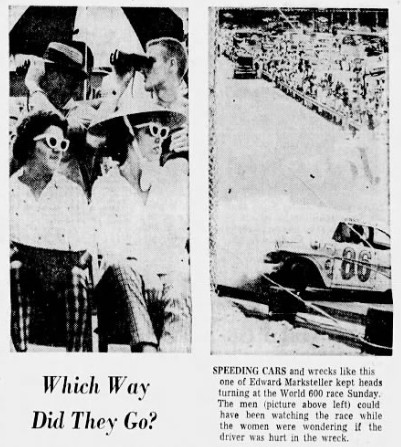
The 600‑mile test, run under blistering heat and before an estimated 60,000 spectators, produced a long string of spinouts, crashes, and mechanical failures. When the dust settled, the machines had taken the punishment while the men walked away.
The most frightening moment came on the 10th lap when Johnny Wolford lost control of his 1960 Ford in a turn. Cotton Owens and Johnny Allen plowed into the spinning car, and Wolford’s machine burst into flames. Wolford leaped out the window just ahead of the fire. His car was destroyed, but he escaped without a mark. Owens and Allen were also unhurt, though their cars were finished.
Roberts, Pistone, and Others Fall Victim to Track
Fireball Roberts, one of the pre‑race favorites, lost a front wheel on his Pontiac in mid‑turn. With the axle digging into the infield, he managed to bring the car to a halt without overturning. Furious and exhausted, he brushed off well‑wishers and left the track in silence.
Many drivers blamed the new speedway’s surface for the rash of failures. Emanuel Zervokis declared, “It’s rough as hell. All the cars will have to be rebuilt after this one.” Tom Pistone, who had been running near the front before breaking an axle on lap 230, said, “I’m not blaming Curtis Turner. He tried to get it ready. But they should stop it. Ball joints, bearings, differentials — they’re breaking because of the track.”
Doug Yates, who blew a tire and hit the rail, said he struck a hole in the pavement. “There are holes all over it,” he said, though he predicted the track would eventually become one of the best once properly resurfaced.
Others were more forgiving. Junior Johnson, who was running third when he hit the rail on lap 290, said, “It’s torn up a little, but not too awful bad.” Ned Jarrett, who wrecked after blowing a tire, said, “There’s a lot of holes, but you can dodge them.”
Smith’s Heartbreak Ends His Dominant Run
The cruelest blow fell on Jack Smith of Spartanburg. Driving a fast and steady Pontiac, Smith led the field by five laps with only 47 remaining when his gas tank split open. He climbed from the car in disbelief, holding his hands apart to show the size of the hole.
Smith sat down in the pits, head lowered, fighting back tears. He had led 198 laps — more than any other driver — and appeared headed for victory until the mechanical failure ended his day.
A Race of Survival
One pit crew member summed up the afternoon as “not a race but a demolition derby.” Holes opened in the 24‑degree turns, rocks shattered windshields, and cars spun repeatedly on the front stretch. Only 24 of the 60 starters were still running at the finish.
Yet despite the chaos, the race produced no serious injuries — a fact that astonished even the most seasoned observers.
The machines suffered. The men survived.