Cincinnati Reds
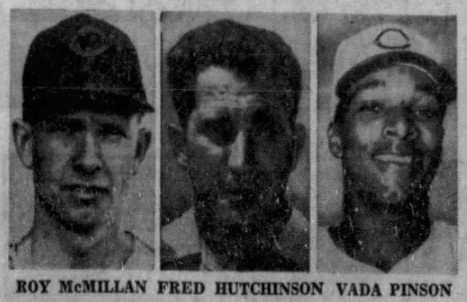
Reds Counting on Power, Pinson’s Punch in ’60 Pennant Bid
Hutchinson Sees Club as “A Factor,” but Pitching Remains the Question
TAMPA, Fla., March 27 — The Cincinnati Reds break camp this spring with one of the National League’s most imposing outfields, a bundle of power, and a manager convinced his club is ready to make itself heard in the pennant race. Whether the Reds can climb higher than last year’s fifth‑place tie, however, may depend on how quickly a rebuilt infield gels and whether a still‑uncertain pitching staff can carry its share of the load.
The brightest spot in the Reds’ picture is the outfield of Gus Bell, Vada Pinson, and Frank Robinson, regarded by many as the finest trio in the league. Pinson, who finished fourth in the batting race last season at .316, has been blistering the ball all spring. Manager Fred Hutchinson goes so far as to say the 21‑year‑old could be “a .400 hitter.”
At shortstop, the Reds boast Roy McMillan, widely considered the best glove man in the league.
New Double‑Play Duo Still Learning
The biggest change comes at second base, where the long‑standing McMillan–Johnny Temple combination has been broken up. Temple’s trade to Cleveland brought Billy Martin and pitcher Cal McLish to Cincinnati. Martin and McMillan are still learning each other’s moves, and Hutchinson admits the new pairing will need time before it clicks like the old one.
McLish, a 19‑game winner last season, is expected to bolster a starting staff that includes Don Newcombe, Bob Purkey, and Joe Nuxhall. The Reds also acquired left‑hander Bill Henry from the Cubs to anchor the relief corps. Hutchinson believes Henry may be the answer to the club’s late‑inning troubles; Cincinnati lost 27 games last year after the seventh inning.
Even so, many observers feel the Reds’ pitching remains short of championship caliber.
Rookie Coleman a Gamble at First
One of Hutchinson’s boldest spring decisions is his plan to give rookie Gordon Coleman the first‑base job. Coleman hit .335 with 30 home runs in the Southern Association last year, and if he can carry that punch to the majors, Robinson will remain in the outfield. But it is a gamble, and Hutchinson knows it.
Two young pitchers, Jay Hook and Jim O’Toole, are also being counted on to take major steps forward. They won only 10 games between them last season, but the Reds believe both have the stuff to become front‑line starters.
Last Year and Prospects
Cincinnati finished 74–80, tied with the Cubs for fifth place. Hutchinson insists the club will be “a factor” this year, pointing to its power and defense.
“This is the most power I’ve had in all my years of managing,” he says. “Our defense is as good as any club’s. It’s up to the pitchers.”
If the arms come through, the Reds could be dangerous. If not, even the league’s best outfield may not be enough to lift them into the first division.
Courtesy of The Philadelphia Inquirer March 28, 1960 via Newspapers.com
Chicago Cubs
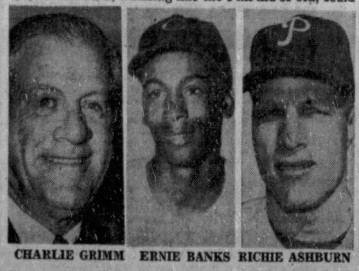
New Faces May Give Cubs Two‑Fisted Punch in ’60 Race
Banks Still the Big Gun; Ashburn and Thomas Add Experience and Power
MESA, Ariz., March 28 — The Chicago Cubs break camp this spring with a mixture of proven power, intriguing new faces, and a handful of question marks that manager Charley “Jolly Cholly” Grimm hopes to iron out before Opening Day. If everything falls into place, the Cubs believe they can climb into the first division for the first time in several years.
The biggest reason for optimism remains Ernie Banks, the National League’s reigning Most Valuable Player. Banks has become as dependable as sunrise, belting 40 home runs and driving in 100 or more runs with clock‑like regularity. The Cubs expect nothing less in 1960.
Adding to the punch is Frank Thomas, acquired from Pittsburgh and swinging like the Thomas of old. If he continues his torrid spring, the Cubs could field one of the league’s most dangerous one‑two power combinations.
And in center field, Richie Ashburn, the former Phillies sparkplug, has looked rejuvenated. Ashburn believes steady daylight baseball at Wrigley Field will help him regain his batting touch, and Grimm says the veteran brings “speed, power, and experience” to a club that sorely needed all three.
Young Pitching Could Blossom
The Cubs also boast a trio of promising young pitchers in Moe Drabowsky, Dick Drott, and Glen Hobbie. All three have shown flashes of brilliance but have yet to put together full, injury‑free seasons. Grimm is counting on the guidance of Del Rice, the former Milwaukee Braves catcher, to help the youngsters reach their potential.
In the bullpen, Don Elston (10–8 last year) remains one of the league’s most reliable relief men.
But Who’s on Third?
The biggest puzzle facing Grimm is the infield — particularly third base. The trade that brought Ashburn cost the Cubs veteran Al Dark, leaving a vacancy that has yet to be filled.
Grimm is considering several possibilities:
- shifting Tony Taylor from second to third,
- converting former Red Sox first baseman‑outfielder Dick Gernert,
- or even moving Frank Thomas in from the outfield.
If Taylor moves, the second‑base job falls to Jerry Kindall, a smooth fielder but light hitter. Grimm admits the infield may be “an experimental laboratory” well into the season.
Men to Watch
Two comeback candidates top the list:
- Frank Thomas, swinging freely again after a down year,
- Richie Ashburn, hoping Chicago sunshine restores his batting eye.
On the mound, Drott and Drabowsky — both plagued by arm trouble last year — pitched semipro ball in California over the winter and have looked sharp in camp.
Last Year and Prospects
The Cubs finished 74–80, tied with Cincinnati for fifth place. Grimm believes the club is poised to move upward.
“We’re in good shape,” he says. “We’ll finish in the first division.”
If the pitching matures and the infield puzzle finds a solution, he may be right.
Courtesy of The Philadelphia Inquirer March 29, 1960 via Newspapers.com
San Francisco Giants
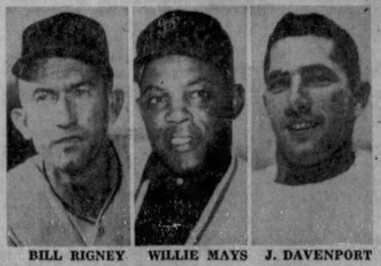
Giants Banking on “Billies” and Big Bats in Tight NL Race
Mays, McCovey, Cepeda Lead Potent Attack; Rigney Confident Pitching Is Strong Enough to Win
PHOENIX, Ariz., March 29 — The San Francisco Giants, already boasting one of the league’s most feared offensive trios, enter the 1960 campaign convinced they have the balance, depth, and pitching strength to make a full‑season run at the National League pennant. Manager Bill Rigney, surveying a roster rich in youth and power, says simply, “We’ll be a contender.”
The Giants’ attack is anchored by the incomparable Willie Mays, the league’s most complete player; Willie McCovey, last year’s sensational mid‑season call‑up; and Orlando Cepeda, the hard‑hitting first baseman turned outfielder. All three have been pounding the ball with authority this spring.
McCovey, who hit .354 after joining the club in July, appears poised to challenge for the batting title. Cepeda, moved to left field after McCovey seized first base, is still learning the outfield, but Rigney insists, “He’ll do all right. We’ll smooth out the rough spots.”
Infield Strong, Blasingame Adds Spark
The Giants field one of the league’s sharpest infields with Jim Davenport, Ed Bressoud, Don Blasingame, and McCovey. Blasingame, acquired from St. Louis, brings speed, polish, and a reliable leadoff bat. His presence has already tightened the club’s defense up the middle.
Davenport, who tore knee cartilage last August and underwent winter surgery, has returned to steady play. But Rigney admits that if Davenport’s knee falters, the club has no comparable reserve to replace him.
Pitching Staff Deep and Experienced
San Francisco’s pitching staff may be its greatest strength. The Giants feature four proven starters:
- Johnny Antonelli
- Mike McCormick
- Sam Jones
- Jack Sanford
All four won consistently last season and form one of the league’s most dependable rotations.
To bolster the staff, the Giants added two more “Billies” — Billy O’Dell and Billy Loes — both expected to reduce the heavy relief burden that wore down the starters late last year. With the added depth, Rigney believes his aces will stay fresher through the long summer grind.
Left‑Handed Power Still Needed
Rigney’s chief concern is the lack of left‑handed hitting. The club moved Tuesday to address that need, acquiring outfielder Jim Marshall from Boston in exchange for pitcher Al Worthington. Marshall is expected to provide some balance to a lineup dominated by right‑handed sluggers.
Last Year and Prospects
The Giants finished third in 1959 with an 83–71 record, just four games out of first place. With their pitching strengthened and their young stars a year older, the club believes it can close that gap.
A fierce three‑way fight with the Dodgers and Braves appears likely.
Rigney offers no bold predictions, but his confidence is unmistakable: “We’ll be a contender.”
Courtesy of The Philadelphia Inquirer March 30, 1960 via Newspapers.com
Los Angeles Dodgers
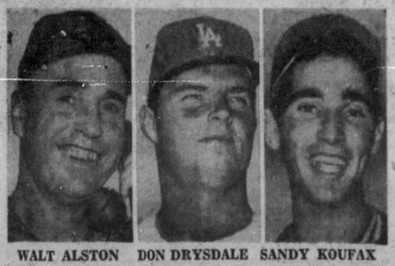
Dodgers Still Look Like the Club to Beat in ’60 Race
Alston Loaded With Pitching; Youth Movement Keeps Champs Strong
VERO BEACH, Fla., March 31 — The world champion Los Angeles Dodgers break camp this spring looking every bit as formidable as the club that stunned the baseball world last October. Manager Walt Alston, surveying a roster deep in pitching and rich in young talent, says simply, “We’re the team to beat.”
It is hard to argue. No club in either league can match the Dodgers’ pitching depth. Alston can choose from six front‑line starters, all under 29:
- Don Drysdale
- Roger Craig
- Stan Williams
- Johnny Podres
- Sandy Koufax
- Danny McDevitt
And as if that weren’t enough, Larry Sherry, the World Series relief hero, is bidding for a starting role. Alston is giving him every chance to win one. Meanwhile, former bullpen ace Clem Labine has shown flashes of his old form, and Ed Roebuck, returning from arm trouble, has looked sharp.
Aging Outfield, but Plenty of Replacements
The Dodgers’ longtime sluggers, Duke Snider and Carl Furillo, are aging and occasionally ailing, but Alston has no shortage of outfield help. Don Demeter, Rip Repulski, Norm Larker, and Chuck Essegian all provide solid depth. Essegian, the World Series pinch‑hit star, is making a strong bid for Furillo’s right‑field job.
The club is so well‑stocked with reserves that two of its brightest prospects — Frank Howard, hailed by some as “the next Ruth,” and outfielder Tommy Davis — may spend another year in the minors simply because there is no room for them.
Infield Still Strong, but Questions Linger
There are few weaknesses on the roster, though some critics wonder whether Jim Gilliam at third and Gil Hodges at first may have slowed a step. Still, no one in camp has threatened either veteran’s job.
At shortstop, Maury Wills — brilliant in last year’s stretch drive — is battling Don Zimmer and Bob Lillis. Alston says he may juggle the infield if Wills falters.
“We could use a slugger,” Alston admits. “We sort of spray our hits.” But with the Dodgers’ pitching, they rarely need to outslug anyone.
Men to Watch
Two pitchers have stood out above the rest this spring:
- Don Drysdale, throwing with the power and command of a 20‑game winner.
- Sandy Koufax, showing the blazing fastball that has long tantalized the Dodgers.
If both fulfill their promise, the Dodgers’ staff could dominate the league.
Essegian is another player drawing attention. Alston says it is “now or never” for the former Phillie.
Last Year and Prospects
The Dodgers are, of course, the reigning world champions, having beaten the White Sox in six games last fall. With their pitching depth, youthful reserves, and the confidence of champions, they enter 1960 as the club everyone else must chase.
“You can’t help being enthusiastic with all the fine‑looking youngsters we have,” Alston says. “Look at the job they did for us last year.”
The Dodgers believe they can do it again.
Courtesy of The Philadelphia Inquirer April 1, 1960 via Newspapers.com
Milwaukee Braves
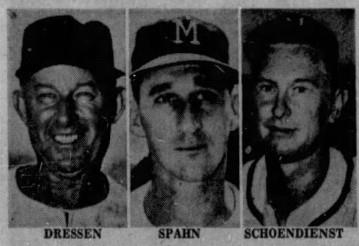
Dressen Shakes the Lead Out of Braves
New Manager Adds Daring to Power; Schoendienst Comeback Holds Key to Pennant Hopes
SARASOTA, Fla., March 30 — The Milwaukee Braves, twice champions and last year co‑winners of the National League flag before bowing to the Dodgers in the playoff, report to the 1960 campaign with a new manager, a new philosophy, and the same old thunder in their bats. Whether that combination can lift them back to the top depends largely on the health of one man — Red Schoendienst — and the success of Chuck Dressen’s bold new program.
Dressen, returning to a big‑league helm after several years away, has wasted no time putting his stamp on the Braves. He wants his club to run — and run hard. He plans more bunting, more hit‑and‑run, more daring on the bases. If it works, Milwaukee’s already formidable attack could become the most dynamic in the league.
The Braves still boast two of baseball’s finest pitchers in Warren Spahn, aging but ageless, and Lew Burdette, who reported late after a holdout but appears strong and ready. Behind them stand veteran Bob Buhl and youngsters Joey Jay and Juan Pizarro, all of whom Dressen intends to use in a five‑man rotation.
At the plate, the Braves remain the league’s most dangerous club. Hank Aaron, Eddie Mathews, Joe Adcock, Del Crandall, and Johnny Logan powered Milwaukee to a league‑leading 177 home runs last season, and there is no sign the well is running dry.
Schoendienst Comeback the Big Question
The biggest uncertainty is the condition of Red Schoendienst, whose absence last year after a battle with tuberculosis left a gaping hole at second base. Schoendienst looks healthy this spring, but Dressen is cautious.
Some critics believe Red may not be good for more than 60 games. If he falters, the Braves will be forced to trade for an established second baseman — a move that could disrupt the club’s balance.
Men to Watch
- Red Schoendienst, whose comeback could determine the Braves’ fate.
- Chuck Dressen, whose aggressive style has already energized the camp.
- Spahn and Burdette, now slated to work every fifth day instead of every fourth.
- Aaron and Mathews, two of the league’s fastest and most powerful hitters — whose baserunning risks could also lead to injuries.
One thing is clear: the Braves are responding to Dressen. The camp is full of fire, hustle, and enthusiasm.
Last Year and Prospects
Milwaukee finished in a first‑place tie last season at 86–68, losing the playoff to the Dodgers. Dressen expects another dogfight with Los Angeles and San Francisco.
“If the Dodgers are our only competition,” he says, “we should have no trouble.”
The Braves have the power, the pitching, and the experience. If Schoendienst holds up — and if Dressen’s daring doesn’t backfire — Milwaukee may again be the club to beat.
St. Louis Cardinals
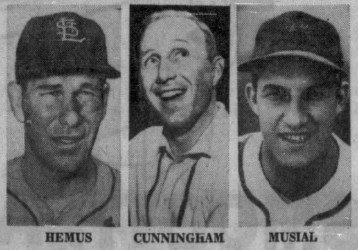
Cards Rely on Solly’s Hunches — and Musial’s Bat — in Bid to Climb Back
Musial, Boyer, White Lead Attack; Pitching Depth Still Thin
ST. PETERSBURG, Fla., April 1 — The St. Louis Cardinals enter the 1960 campaign with a lineup rich in hitters, a handful of promising arms, and a manager who insists his club will be in the pennant fight. But whether Solly Hemus’ hunches can overcome the club’s thin depth and defensive concerns remains the question as Opening Day approaches.
The Cardinals’ strength lies in their bats. Stan Musial, recovering from last year’s rare slump, has looked sharper this spring and is determined to prove he has one more .300 season in him. Ken Boyer, Joe Cunningham, Bill White, and newcomer Daryl Spencer give the club a solid middle‑order punch.
Spencer, acquired from the Giants in the Don Blasingame trade, is expected to drive in more runs than the slick‑fielding second baseman he replaces. Hemus admits the deal weakened the defense but says, “We had to gamble. Spencer will bat in a lot more runs and hit homers, too.”
Pitching Has Bright Spots — and Gaps
The Cardinals’ top three starters — Vinegar Bend Mizell, Larry Jackson, and former Pirate Ronnie Kline — have all thrown well this spring. Hemus is particularly bullish on Kline.
“I have a hunch Kline will have a big year,” he says.
Behind them, however, the depth thins quickly. Ernie Broglio (7–12 last year) and young Bob Miller (4–3) are the next best options, and both remain unproven over a full season.
In the bullpen, Lindy McDaniel may emerge as a key figure. Hemus is counting on him to stabilize late innings for a staff that cannot afford many breakdowns.
Musial to Rest More; Outfield in Flux
Musial will sit out the second game of doubleheaders, with Cunningham shifting to left field when needed. The rest of the outfield will be a revolving door, with Bob Nieman and Leon Wagner battling for time in left or filling in when Cunningham moves.
White, though more natural at first base, will patrol center field. With so many players out of their best positions, Hemus concedes the outfield may produce “spectacular catches of routine fly balls.”
Men to Watch
- Lindy McDaniel, who may become one of the league’s top relief men.
- Stan Musial, entering the twilight of his career but still capable of carrying the club if his legs hold up.
- Ronnie Kline, Hemus’s personal pick to surprise the league.
Last Year and Prospects
The Cardinals finished seventh in 1959 with a 71–83 record, 16 games out. Hemus insists the club will be in the pennant race this year.
But as one observer put it, Solly may be “running an elevator in a one‑story building.”
Still, with Musial swinging freely again and the pitching showing early promise, the Cardinals could be a tougher club than last year’s standings suggest.
Courtesy of The Philadelphia Inquirer April 2, 1960 via Newspapers.com
Pittsburgh Pirates
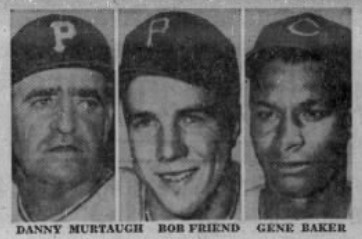
Five Pirate Keys Must Fire for Bucs to Make Pennant Noise in ’60
Friend, Groat, Mazeroski, Skinner, Virdon Must Rebound for Murtaugh’s Club to Contend
FORT MYERS, Fla., April 2 — The Pittsburgh Pirates enter the 1960 season with a club that looks, on paper, capable of climbing higher than last year’s fourth‑place finish. But as manager Danny Murtaugh puts it, “five key men must come through” if the Bucs are to make a serious run at the National League flag.
Those five — Bob Friend, Dick Groat, Bill Mazeroski, Bob Skinner, and Bill Virdon — all slipped noticeably last season after standout years in 1958. Friend fell the farthest, tumbling from a 22‑win campaign to an 8–19 mark. The others dropped 25 to 40 points in batting average.
“If they come through,” Murtaugh says, “we have a chance. A very good chance, I might add.”
Plenty of Bats — If They Wake Up
The Pirates’ hitting sagged last year, but the potential remains. Dick Stuart, Skinner, Virdon, Groat, Don Hoak, and Mazeroski form a lineup that can produce runs if they return to form. Stuart, still learning first base, is improving but remains shaky compared with other first‑sackers.
A bright spot this spring has been Gino Cimoli, the former Dodger and Cardinal, who has been hitting with authority in his bid to win a regular outfield job.
Pitching Staff Has Strong Core
The Pirates’ pitching strength lies in their front four:
- Bob Friend
- Vern Law
- Harvey Haddix
- Roy Face, baseball’s most successful relief pitcher
Face, who saved 18 games last year, remains the anchor of the bullpen.
The battle for the fourth starting spot is lively. Bennie Daniels and Jim Umbricht, who combined for a spring no‑hitter against Detroit, are competing with Don Gross, once a big winner, for the job.
The defense, particularly the Groat‑Mazeroski combination at second, remains one of the club’s strengths.
Depth Still a Problem
The Pirates’ biggest weakness is their lack of depth. The addition of Hal Smith, the former Kansas City catcher, helps a bit — he can catch and play third — but not enough to erase the concern.
A wild card is Gene Baker, now 35 and returning after a year and a half lost to knee trouble. Baker has looked surprisingly sharp in squad games and could provide valuable infield support and occasional long‑ball power if his legs hold up.
Last Year and Prospects
The Pirates finished fourth in 1959 with a 78–76 record, nine games out. Murtaugh believes the club is better than that showing.
“These fellers need a Friend,” one observer quipped — and if Friend rebounds, the Pirates could be in the thick of the race.
As Murtaugh says, they have “a very good chance.”
Courtesy of The Philadelphia Inquirer April 3, 1960 via Newspapers.com
Boston Red Sox
Red Sox Face Season of Patchwork as Williams Leads Youthful Club
Jensen, White Retire; Holes Remain in Pitching and Behind Plate
SCOTTSDALE, Ariz., April 3 — The Boston Red Sox approach the 1960 campaign with more questions than answers, a handful of promising youngsters, and the familiar presence of Ted Williams, who is working harder this spring than he has in years. But even with Williams back in left field and swinging with renewed vigor, the Red Sox still have many holes to darn before they can think about climbing the American League ladder.
Williams, who dipped below .300 last season for the first time in his career, has been unusually active in camp and has played regularly in the outfield alongside Gene Stephens and former Cub Bobby Thomson. At third base, Frank Malzone remains the club’s steadiest hand, coming off a 92‑RBI season.
At second, Pete Runnels (.314) is the club’s most reliable left‑handed bat, but he may be shifted to first base if Vic Wertz or slugging prospect Don Jackson (30 homers at Indianapolis) fails to claim the job.
Pitching Shows Promise — If It Holds Together
The Red Sox believe they have two potential 20‑game winners in Tom Brewer (10–12) and Ike Delock (11–6). Former Yankee Tom Sturdivant may also help stabilize the staff.
But the club is short on left‑handed pitching. That burden may fall on rookies Tom Borland and Ted Bowsfield, who posted 14–8 and 10–5 records, respectively, at Minneapolis. Manager Billy Jurges, who took over last July 4, says the staff’s success depends on “the old fellows, the young fellows — it depends on all of them.”
Retirements Leave Big Gaps
The offseason retirements of outfielder Jackie Jensen and catcher Sammy White have left Boston with two glaring vacancies. Unless the Red Sox can swing a trade, they will enter the season with only one experienced catcher, Haywood Sullivan.
The roster is young despite its veteran names, and Jurges admits the club may need time to develop.
Man to Watch
Switch‑hitting Pumpsie Green, 15 pounds heavier than a year ago, could become the club’s first Negro regular. Green hit .233 in 50 games after being called up last season, but his .320 average at Minneapolis suggests he may be ready for more responsibility — especially if Runnels moves to first.
Last Year and Prospects
The Red Sox finished sixth in 1959 with a 71–79 record, 20½ games out. Most observers expect them to land in the same neighborhood this year.
Jurges takes the predictions in stride.
“This club, in general, is a young one which must develop,” he says. “The players may be ready this year or they may have to wait. If they pick us for sixth or seventh — well, that’s where they pick us.”
Courtesy of The Philadelphia Inquirer April 4, 1960 via Newspapers.com
Kansas City Athletics
A’s Jacked Up for ’60 — Not High, But Definitely Up
Plenty of Punch in Outfield; Pitching a Spring Surprise, Infield Still a Puzzle
WEST PALM BEACH, Fla., April 4 — The Kansas City Athletics, long mired in the second division, report to the 1960 starting line with a club that is not expected to contend — but one that may be better than most observers think. Manager Bob Elliott, taking over for Harry Craft, has a team with power, a deep outfield, and a pitching staff that has surprised everyone this spring. Whether that will be enough to climb the standings remains to be seen.
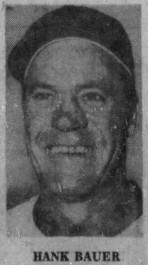
The A’s tied Cleveland for the American League team batting lead last year at .262 and finished second in home runs. Their outfield remains their strongest department, with Norm Siebern in left, Bill Tuttle in center, and 37‑year‑old Hank Bauer in right. Behind them stand capable reserves: Russ Snyder, Whitey Herzog, Leo Posada, and Bob Cerv, who is attempting to convert to first base.
Catching, long a weak spot, has been bolstered by the arrivals of Hank Foiles and Pete Daley, joining veteran Harry Chiti.
Pitching Looks Better Than Expected
The A’s pitching staff, often their undoing, has been one of the surprises of the spring. Veterans Ned Garver, Johnny Kucks, Ray Herbert, and Bud Daley lead the rotation, while a deep supporting cast — Bob Grim, Don Larsen, Bob Trowbridge, John Tsitouris, and Dick Hall — has shown unexpected sharpness.
Hall, the former Swarthmore College star and ex‑Pirate, posted an 18–5 record with a 1.87 ERA at Salt Lake City last year and could be the club’s sleeper.
Still, Elliott admits he does not yet know whether the staff has improved enough to lift the club out of the lower half.
Infield a Patchwork of Rookies and Experiments
The biggest question mark is the infield, which Elliott calls “my biggest headache.” The entire left side is made up of rookies:
- Kenny Hamlin, shortstop, hit .251 at Columbus and is the key to the club’s defensive hopes.
- Lou Klimchock, a .315 hitter at Shreveport, moves from second base to third.
The rest of the infield is also in flux. Jerry Lumpe, once a shortstop, is now at second. Marv Throneberry holds first base but may be platooned with Cerv.
If Hamlin falters, Elliott will reshuffle the entire infield: Lumpe back to short, Klimchock to second, and Dick Williams to third.
Men to Watch
- Hank Bauer, the club’s “money player,” still dangerous at 37.
- Bill Tuttle, one of the league’s best defensive center fielders.
- Norm Siebern, a steady hitter with improving power.
- Jerry Lumpe, whose versatility may be crucial to Elliott’s plans.
Last Year and Prospects
The A’s finished seventh in 1959 with a 66–88 record, 28 games out. They are not expected to contend this year, but with their hitting and improved pitching, they could finish high in the second division.
As one observer put it, the A’s are “jacked up — not high, but up.”
Courtesy of The Philadelphia Inquirer April 5, 1960 via Newspapers.com
Detroit Tigers
Tigers Show Sharp Teeth in ’60 Attack
Lary, Bunning, Foytack, Mossi Form Strong Core; Outfield Best in League
LAKELAND, Fla., April 5 — The Detroit Tigers break camp this spring with one of the American League’s most formidable offensive trios and a pitching staff anchored by four proven winners. Whether that will be enough to lift them higher than last year’s fourth‑place finish depends largely on depth — a commodity manager Jimmy Dykes admits he is still searching for.
The Tigers’ strength begins with their front four pitchers: right‑handers Frank Lary, Jim Bunning, Paul Foytack, and left‑hander Don Mossi. Together they accounted for 65 victories last season. The rest of the staff, however, produced only 11 wins, and Detroit is still hunting for a dependable fifth starter.
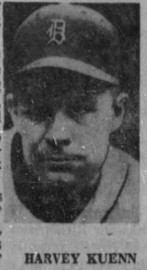
Offensively, the Tigers boast what may be the league’s finest outfield. Harvey Kuenn, last year’s batting champion at .353, teams with Al Kaline (.327, 94 RBI, 27 homers) and Charley Maxwell (.251, 95 RBI, 31 homers) to form a trio that can match any in baseball. At third base, Eddie Yost remains a steady hitter, and Frank Bolling provides solid play at second.
Depth Still a Worry
Dykes insists the club is “much stronger” than last year, but the depth chart suggests otherwise. If anything happens to Kuenn, Kaline, or Maxwell, the Tigers’ only outfield replacements are Johnny Groth (.235) and Neil Chrisley (.132). Behind the plate, Red Wilson is capable, and Lou Berberet can hit with power, but neither is the first‑rate catcher the club would like.
On the mound, Detroit is trying to find that elusive fifth starter in Ray Narleski (4–12 as a reliever last year) or Ray Semproch, who went 3–10 for the Phillies.
Men to Watch
One of the most intriguing figures in camp is Steve Bilko, the 250‑pound slugger who continues to get chances because of his bat. Bilko hit .305 with 26 homers and 92 RBI for Spokane last year. The Tigers do not expect grace around first base — only power.
Another ex‑Phil, Chico Fernandez, will open the season as the No. 1 shortstop and will be watched closely.
Last Year and Prospects
The Tigers finished fourth in 1959 with a 76–78 record, 18 games out. Dykes believes his club can challenge the league’s top teams.
“These are by no means paper Tigers,” he says. “I don’t fear Chicago, Cleveland, or New York. They’re the ones we’ll have to beat — and we could.”
Detroit may not be the favorite, but with its front‑line pitching and heavy‑hitting outfield, the Tigers could claw their way into the race.
Courtesy of The Philadelphia Inquirer April 6, 1960 via Newspapers.com
Washington Senatores
Cookie’s Calm Touch Gives Senators New Confidence for ’60
Pascual Leads Staff; Killebrew, Allison, Lemon Supply Power, but Defense Still a Worry
ORLANDO, Fla., April 6 — The Washington Senators, long the American League’s doormat, break camp this spring with a surprising sense of optimism — much of it supplied by their unflappable manager, Cookie Lavagetto, whose quiet confidence has rubbed off on his players. Whether that confidence can lift the Nats out of the cellar depends on pitching, defense, and a handful of newcomers who must prove they belong.
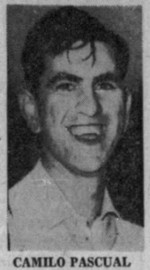
The Senators’ biggest asset is Camilo Pascual, the 26‑year‑old Cuban right‑hander who went 17–10 last season and is regarded by some as the league’s best pitcher. Several clubs tried to pry him loose over the winter, but Washington wisely held firm. Behind Pascual stand Pedro Ramos (13–19) and Russ Kemmerer (8–17), both better than their records suggest.
Submarine specialist Dick Hyde, who slumped to 2–5 last year, has flashed his 1958 form this spring and could again become one of the league’s top firemen.
Plenty of Power in the Lineup
Washington finished second only to Cleveland in home runs last year with 163, and the power remains intact. Harmon Killebrew (42 homers), Bob Allison (30), and Jim Lemon (33) form one of the league’s most dangerous long‑ball trios.
Rookie outfielder Dan Dobbek, a left‑handed hitter who belted 23 homers at Chattanooga, may add even more punch.
Lavagetto believes the Senators will climb out of the basement, and the players seem to share his conviction.
Defense Still the Big Question
The Senators must improve in all three departments — pitching, fielding, and hitting — after ranking fifth, seventh, and eighth, respectively, in 1959. The club traded away two power hitters, Clint Courtney and Roy Sievers, to acquire catcher Earl Battey and second baseman Billy Gardner, both strong defensively but light with the bat.
With Faye Throneberry at first and Killebrew at third, Washington is counting on Gardner and shortstop Billy Consolo to shore up the middle infield.
Man to Watch
The most intriguing figure in camp is rangy left‑hander Jim Kaat (6‑4, 205), who split his decisions at Chattanooga and lost his only two with Washington last year. Lavagetto predicts that “within a year or so” Kaat will be the best pitcher in the league — and he may already be the best southpaw on the staff.
Last Year and Prospects
The Senators finished eighth in 1959 with a 63–87 record, 28½ games behind Chicago but only a half‑game behind the seventh‑place A’s.
“Defense is the key to this club,” Lavagetto says. He is satisfied with his pitching and power and believes the Senators can win 70 to 75 games, perhaps even flirt with .500.
That would indeed be a neat trick — but for the first time in years, Washington believes it can pull one off.
Courtesy of The Philadelphia Inquirer April 7, 1960 via Newspapers.com
Baltimore Orioles
Orioles Counting on Chicks to Hatch in Youth‑Driven ’60 Campaign
Richards Builds Around Young Arms; Hansen, Estrada, Robinson Lead New Wave
MIAMI, Fla., April 7 — The Baltimore Orioles, one of the American League’s most youth‑laden clubs, approach the 1960 season with a flock of promising youngsters and a manager who has made a career out of developing them. Paul Richards, master strategist and platoon specialist, is again attempting to turn raw talent into a contender — and this spring he has more of it than ever.
“This is how young we are,” Richards says. “Our first four pitchers are all under 22.”
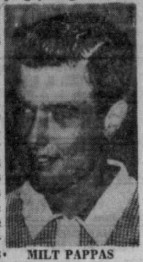
Those four — Milt Pappas (20), Jerry Walker (21), Jack Fisher (21), and Chuck Estrada (22) — form the core of a rotation Richards hopes can carry the club until mid‑season, when he expects the kids to have learned from their early mistakes. Behind them stand veterans Hoyt Wilhelm, the knuckleballing marvel, and Skinny Brown.
Estrada, who struck out 178 batters at Vancouver last year, may be the most electric of the group.
Young Infield, Veteran Bats
The Orioles’ infield is nearly as youthful as their pitching. Rookie Ronnie Hansen, a tall, smooth‑fielding shortstop, has won the starting job despite hitting only .256 at Triple‑A. Richards compares him to Marty Marion in the field.
At third, Brooks Robinson anchors the defense, while rookie Marv Breeding holds a slight edge over Jerry Adair at second base.
Behind the plate, the Orioles rely on 25‑homer man Gus Triandos, with newly acquired Clint Courtney providing veteran support. In left field, 37‑year‑old Gene Woodling remains the club’s most polished hitter, though Richards knows he will need rest. Jackie Brandt, the former Giant, takes over in center and should strengthen the defense.
Youth Brings Promise — and Growing Pains
Richards is realistic about the hazards of relying on so many youngsters.
“If you are young, you must make the first mistake,” he says. “We’ll make them. I can only hope our pitching can carry us to mid‑season. By that time these kids may have gotten over the mistakes.”
The club has only three left‑handers, and Woodling’s age and Hansen’s past spinal surgery add to the concerns.
Men to Watch
- Hoyt Wilhelm, who will begin the season as a starter but may return to the bullpen if the kids hold up.
- Ronnie Hansen, whose glove could make him a star.
- Chuck Estrada, the hard‑throwing right‑hander with strikeout stuff.
Last Year and Prospects
The Orioles finished sixth in 1959 after collapsing from the first division in mid‑September. Richards believes this year’s club will be better.
“If the kids are ready,” he says, “we’ll give some clubs a few thrills.”
Baltimore may not be a favorite, but with Richards guiding a talented youth movement, the Orioles could surprise more than a few teams before the summer is over.
Cleveland Indians
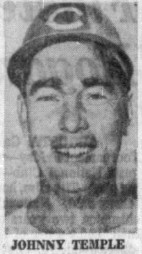
Indians’ Hopes Ride on Battery Power — If It Runs Low, Tribe May Sink
Gordon Praises Infield; Pitching Strong but Score Must Return to Form
TUCSON, Ariz., April 8 — The Cleveland Indians, who led the American League into mid‑July last season before fading to second place, return this spring with a club that manager Joe Gordon calls the best he has ever had. Whether the Tribe can stay in the race this time depends largely on its pitching — and on whether its rebuilt battery can hold up through the long summer grind.
“I wouldn’t trade my infield for anything,” Gordon says, and with good reason. Newly acquired Johnny Temple, who hit .311 for Cincinnati last year, replaces the fiery Billy Martin at second. Vic Power remains one of the league’s finest first basemen, Woody Held returns at shortstop, and former White Sox infielder Bubba Phillips takes over at third. Gordon insists the quartet has “power, balance, speed, and defensive strength.”
The outfield is equally potent. Tito Francona, who hit .363 last year, anchors left field. In center, Jim Piersall and Carroll Hardy are battling for the job. And in right stands the Tribe’s biggest gun, Rocky Colavito, who belted 42 homers and drove in 111 runs in 1959.
Pitching Staff Deep — If Score Rebounds
The Indians’ pitching staff is anchored by Gary Bell (16–11), Jim Perry (12–10), and Mudcat Grant (10–7). The key, however, is left‑hander Herb Score, once the league’s strikeout king before a line drive nearly cost him his sight three years ago. Score went 9–11 last season and must return to form if Cleveland is to replace the 19 wins lost when Cal McLish was traded to Cincinnati for Temple.
Veteran Bob Lemon, 18 pounds lighter and looking rejuvenated, joins seasoned southpaw Jack Harshman, fastballer Bobby Locke, and steady Bob Grim, obtained from Kansas City, to round out a deep staff.
Catching Still a Problem
General manager Frank Lane created a stir over the winter when he traded catcher Russ Nixon to Boston — only to have the deal voided when Sammy White retired. Nixon returned to Cleveland, but the position remains unsettled.
Gordon is high on Joe Romano, who hit .294 last year and may get a chance if the other catching options falter.
Men to Watch
- Joe Romano, potential power‑hitting catcher.
- Carroll Hardy, former pro football halfback battling Piersall for center field.
- Herb Score, whose comeback could determine the Tribe’s fate.
Last Year and Prospects
The Indians finished second in 1959 with an 87–67 record, five games behind the White Sox after leading the league into mid‑July.
Gordon believes this year’s club is stronger.
“If our young pitchers come through,” he says, “we will give all clubs a run for their money. We are aiming for the top, and I can see no reason why we won’t be there at the end of the season.”
The Tribe has the bats, the gloves, and the arms — provided the battery stays charged.
Courtesy of The Philadelphia Inquirer April 9, 1960 via Newspapers.com
Chicago White Sox
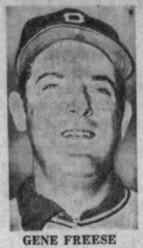
Go‑Go Sox Add Boom‑Boom for ’60 Repeat Bid
Champions Return Intact; Freese, Minoso, Sievers Bring Needed Power
SARASOTA, Fla., April 10 — The Chicago White Sox, the club that finally toppled the mighty Yankees last summer, return to the 1960 wars with their championship cast virtually intact — and with something they sorely lacked a year ago: power.
The “Go‑Go Sox,” long known for speed, hustle, and airtight defense, now boast a lineup fortified by Gene Freese, acquired from the Phillies; the ever‑dangerous Minnie Minoso; and slugger Roy Sievers, who can play first or the outfield. Add these bats to the steady punch of Sherm Lollar, Ted Kluszewski, and the incomparable double‑play duo of Nellie Fox and Luis Aparicio, and the White Sox suddenly look like a club that can run and slug.
On the mound, Early Wynn (22–10) again heads a formidable staff that includes Bob Shaw (18–9), Dick Donovan, and veteran left‑hander Billy Pierce. In the bullpen stands rubber‑armed Gerry Staley, who relieved in 67 games last year and remains one of the league’s most reliable firemen.
Manager Al Lopez has depth everywhere. Earl Torgeson backs up Kluszewski at first, Sam Esposito fills in on the left side of the infield, and Billy Goodman can play almost anywhere. Sievers may hit his way into a regular job, and Freese is expected to provide the long‑ball threat the Sox lacked in 1959.
Age a Growing Concern
But the White Sox are not without worries. Several of their key men are on the far side of their prime. Kluszewski is 35, Minoso admits to 36, Staley is 39, and Wynn is 40. They cannot go on forever, and it is doubtful Wynn can duplicate last year’s brilliant performance.
Still, Lopez is confident his veterans have enough left for another run.
Men to Watch
- Gene Freese, who “got out of jail” when the Phillies traded him, and whom Lopez expects to supply much‑needed punch.
- Billy Pierce and Dick Donovan, both of whom pitched in tough luck last year and lost more than they won.
- Frank Baumann, the former Red Sox southpaw who could be the sleeper of the staff.
Last Year and Prospects
The White Sox finished first in 1959 with a 94–60 record, five games ahead of the Yankees, before falling to the Los Angeles Dodgers in the World Series.
Lopez doesn’t hesitate when asked about 1960.
“I think the White Sox will win,” he says.
Not many are disputing him.
Courtesy of The Philadelphia Inquirer April 10, 1960 via Newspapers.com
New York Yankees
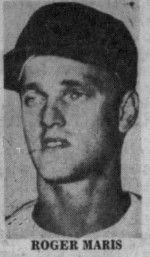
Yankees Enter ’60 Season With Power—But Plenty of “Ifs”
Maris Joins Mantle and Skowron; Pitching Remains the Great Question Mark
ST. PETERSBURG, Fla., April 10 — The New York Yankees, kings of baseball for more than a decade, break camp this spring with a roster full of familiar stars, a few new weapons, and more question marks than Casey Stengel would like to admit. The talent is there, the maneuverability is there — but the “ifs” are big ones, and the Yankees’ hopes for reclaiming the American League flag rest squarely upon them.
The return of Bill Skowron at first base and the arrival of Roger Maris from Kansas City give the Yankees a lineup that should score far more runs than last year’s club, which was shut out 14 times. Mickey Mantle, battered and bruised through much of 1959, is expected to rebound sharply — if he can stay in one piece. Stengel believes Mantle’s .285 average and 75 RBIs last year were only a hint of what he can do when healthy.
At second base, Bobby Richardson has blossomed into one of the league’s finest, and behind the plate the Yankees boast the best catching tandem in baseball: Yogi Berra and Elston Howard. Add Stengel’s legendary knack for platooning and improvisation, and the Yankees still look like a club built to win.
Pitching the Major Concern
But the pitching — always the backbone of Yankee dynasties — is far from certain. Bob Turley, the 1958 Cy Young winner, must rediscover his old form. Whitey Ford must again beat the contenders instead of merely the second‑division clubs. And fireballer Ryne Duren must regain the hop on his fastball that terrified hitters two years ago.
Those are all big “ifs,” and the Yankees have more. Young pitchers Jim Coates, Ralph Terry, Johnny James, and Bill Short must prove they belong. Tony Kubek, the versatile youngster, still must show he can handle shortstop every day. And Hector Lopez, who struggled badly at third base last season, now must prove he can handle right field.
Men to Watch
Stengel’s eyes will be fixed on three men who could form the league’s most dangerous 3‑4‑5 punch:
- Mickey Mantle
- Bill Skowron
- Roger Maris
If all three stay healthy, the Yankees could again become the league’s most feared offensive club.
On the mound, righthander Art Ditmar, who won 13 games despite poor support last year, may be the stopper Stengel desperately needs.
Last Year and Prospects
The Yankees finished third in 1959 with a 79–75 record, 15 games behind the champion White Sox — a rare stumble for a club accustomed to October baseball.
“I’ll have to find out about my pitching,” Stengel says. And that is the heart of the matter. If the pitching holds, the Yankees could make a strong run at their 10th pennant in 12 years.
If it doesn’t, the American League race may have a very different look.
Philadelphia Phillies
‘New’ Phillies Still Look Like Old Phillies — Destined for Cellar Again
Pitching Improved, Defense Better, But Lack of Power and Spirit Still Haunts Club
MIAMI, April 9 — The Phillies have spent the winter reshaping, retooling, and re‑imagining themselves, but as the 1960 season approaches, the hard truth remains: the club that finished last two years running appears headed for the same fate again.
The Carpenter ownership has made more sweeping personnel changes this spring than at any time since the war years, and the farm system — after its finest showing in history — has begun to produce the kind of prospects that baseball men elsewhere rank among the top three or four in the majors. Yet even with the influx of youth and the shuffling of veterans, the Phils still seem several steps behind the rest of the National League.
There are encouraging signs — better pitching, improved defense in the outfield and behind the plate, and a stronger bench — but not enough of them. The club remains short on power, short on spirit, and short on the kind of hitters who can handle good pitching.
Unless pleasant surprises blossom in Philadelphia and unexpected disappointments strike elsewhere, the Phils appear destined for another season at the bottom.
Pitching: The Brightest Spot
The Phillies’ best hope lies on the mound. Robin Roberts, Gene Conley, Jim Owens, and Don Cardwell again form the core of the rotation, and each is capable of winning 15 games even with modest support.
Conley, the club’s most effective pitcher last year, must again make the quick conversion from basketball to baseball. Owens has been slow rounding into form and still carries the shadow of last season’s shoulder trouble.
Help may come from newcomers. John Buzhardt, the ex‑Cub, and Ruben Gomez, one of the most impressive pitchers in camp, offer depth. The biggest surprise has been the comeback of Curt Simmons, the left‑hander who has looked far better than expected.
In the bullpen, Dick Farrell appears to have rediscovered his old fireballing form. If he anchors the relief corps, manager Eddie Sawyer will have fewer sleepless nights.
Catching: Young but Sound
Rookie Jim Coker is expected to do most of the receiving. A fine mechanical catcher with a strong arm and some power, Coker’s inexperience with major‑league hitters may cost the club early.
Behind him are Valmy Thomas, a disappointment last year, and rookie Clay Dalrymple. All three are better defensively than last year’s regular, Carl Sawatski, but none can match Sawatski’s bat.
Infield: Patchwork and Possibilities
First Base: Ed Bouchee, who led the regulars with a .285 average, remains a puzzle — a hitter with potential who has yet to fulfill it. He is sure‑handed but slow.
Second Base: Sawyer’s boldest gamble is shifting Frank Herrera, the International League’s triple‑crown winner, to second base. Herrera has never played the position but has shown surprising aptitude, though his size limits his range. If Bouchee is injured, Herrera moves to first and Ted Lepcio or Bobby Malkmus takes over at second.
Shortstop: Joe Koppe, who took over last June, may be the most improved player on the club. Strong‑armed and aggressive at the plate, he has secured the job while Ruben Amaro completes military duty.
Third Base: Veteran Alvin Dark will handle most of the work. Though no longer a standout defensively, he remains a fine hitter and one of baseball’s best hit‑and‑run men. Lepcio will spell him and add occasional power.
Outfield: Musical Chairs Again
Left Field: A platoon of John Callison (vs. right‑handers) and Bobby Gene Smith (vs. left‑handers) will start. Callison’s knee has slowed him, but his potential remains high.
Center Field: Bobby Del Greco, one of the finest defensive outfielders in baseball, gets the first chance. If he hits .280, fans may forget Richie Ashburn’s departure. If he falters, Smith or Ken Walters will step in.
Right Field: Another platoon: Tony Curry, the promising Bahamian rookie, and Walters. Curry may be rushed too quickly and his glove remains suspect. Wally Post, slow to regain timing, could claim the job by June.
Bench: Better Than Before
Sawyer will carry 28 players for the first month before trimming to 25. The versatility of Lepcio, Malkmus, and several outfielders gives the club more maneuverability than last year.
Conclusion: Pitching Helps, But Not Enough
The Phillies’ pitching should keep them in most games, but poor clubs have a knack for losing the close ones — and this club fits the pattern. They lack power, lack the ability to capitalize on opponents’ mistakes, and lack the spark that turns tight games into victories.
A fast start is essential to build confidence in what remains a lackluster aggregation. Without it, 1960 may look all too much like 1959 — and 1958.
Courtesy of The Philadelphia Inquirer April 10, 1960 via Newspapers.com