Courtesy of The San Francisco Chronicle February 29, 1960 via Newspapers.com
A Team Running on Empty
The Americans entered the final morning game physically drained. Their victories over Canada and the Soviet Union had been punishing, high‑intensity contests that left the players bruised and mentally fatigued. Against Czechoslovakia, they fell behind twice and trailed 4–3 entering the third period. For a moment, it appeared that the emotional toll of the previous days might finally catch up with them.
But the final period revealed the depth of their resolve. With only 14 minutes remaining, the U.S. team transformed from a sluggish, tentative group into the relentless force that had stunned the hockey world all week.
A Six‑Goal Explosion
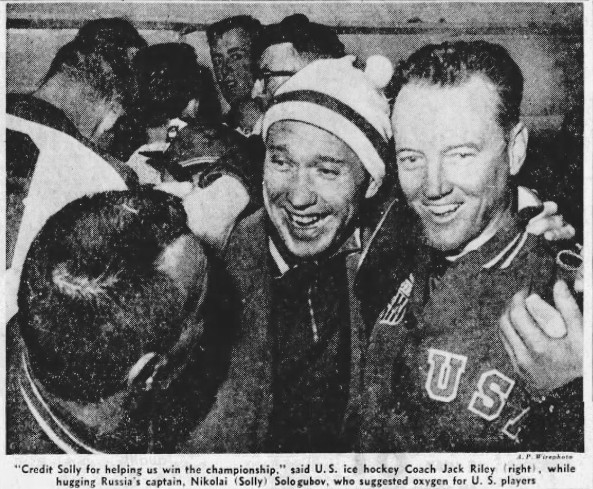
The turning point came from an unlikely source: a gesture from Soviet captain Nikolai Sologubov. At the end of the second period, noticing the Americans’ exhaustion, he approached U.S. coach Jack Riley and mimed gasping for air and using an oxygen mask. Riley understood immediately. Moments later, the U.S. players were inhaling oxygen on the bench—a brief but revitalizing boost.
The effect was immediate. Roger Christian tied the game early in the third period, taking a pass from his brother Bill and firing it home. The arena, only half full due to the early hour, erupted with a roar that echoed across the valley.
From there, the Americans unleashed one of the most explosive stretches of scoring in Olympic hockey history:
- Bob Cleary scored to give the U.S. a 5–4 lead.
- A Czech penalty opened the floodgates.
- In just 1 minute and 17 seconds, the Americans scored three times—Cleary again, Roger Christian, and Bill Cleary on a solo rush.
- Roger Christian added a fourth goal late in the period to complete the rout.
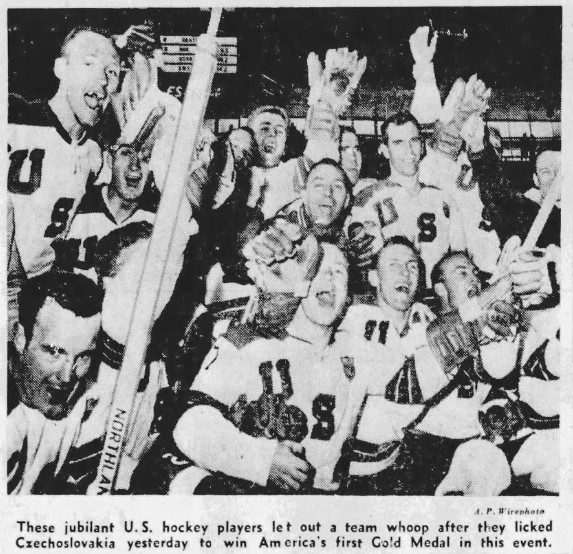
By the final horn, the U.S. had scored six goals in the last period and five in under seven minutes, turning a precarious deficit into a commanding victory.
Heroes Across the Ice
Roger Christian’s four‑goal performance became one of the signature achievements of the tournament. Bob Cleary added two goals, while Bill Cleary, Weldon Olson, and Bob McVey each contributed one. The scoring reflected the team’s hallmark throughout the Games: balanced lines, unselfish play, and a willingness to seize momentum whenever it appeared.
The Americans’ undefeated record—five straight wins in the final round—secured the gold medal outright. Canada’s 8–5 victory over the Soviet Union later that day confirmed the final standings: the United States first, Canada second, and the Soviet Union third.
A Moment of Sportsmanship
Despite the intensity of the competition, the post‑game scene reflected the Olympic spirit. After the final horn, the Soviet players—who had helped revive the Americans with their oxygen gesture—lined up in traditional fashion. Moments later, both teams mingled, shook hands, and embraced. U.S. defenseman Robert Owen and Soviet player Genrikh Sidorenkov even shared a celebratory hug.
It was a moment that captured the essence of the Games: fierce competition followed by mutual respect.
A Historic First for American Hockey
The United States had never before defeated the Soviet Union in championship play. They had never before won the Olympic hockey title. In 1960, they accomplished both within 24 hours.
The victory marked a turning point in the sport’s development in the United States. A team of amateurs—students, servicemen, and working‑class athletes—had toppled the world’s most powerful hockey nations. Their triumph at Squaw Valley laid the groundwork for the sport’s growth in America and foreshadowed the nation’s future Olympic successes.
Courtesy of The San Francisco Chronicle February 29, 1960 via Newspapers.com
A sweeping American triumph in ice hockey became one of the defining emotional peaks of the 1960 Winter Olympics, a moment shaped not only by athletic grit but by the surprising camaraderie that emerged amid Cold War tensions. The United States’ 9–4 victory over Czechoslovakia on February 28 did more than secure the nation’s first Olympic hockey championship—it crystallized the spirit of an Olympics that repeatedly defied expectations and political boundaries. The attached article captures this moment through the voices of those who lived it, including the remarkable presence of Soviet captain Nikolai Sologubov, who “told us to use it when he came into the dressing room at the end of the second period and even helped administer it,” as coach Jack Riley recalled.
A Turning Point in an Unlikely Tournament Run
The American team entered Squaw Valley as underdogs, overshadowed by the established powers of Canada, the Soviet Union, and Czechoslovakia. Yet by Day 11, the U.S. had strung together a run that would become part of Olympic lore. Their victory over the Soviets the previous day—described by Riley as having “took a lot out of us” —set the stage for a final test of endurance and resolve.
The early-morning start against the Czechs, combined with the emotional toll of the Soviet match, left the Americans drained. The team’s use of oxygen between periods, a suggestion from Sologubov, became one of the most memorable anecdotes of the Games. It symbolized the unusual blend of rivalry and respect that characterized the 1960 tournament, where athletes from opposing political systems often found common ground in the shared demands of competition.
A Final Period That Defined an Era
The United States entered the third period trailing, but what followed was one of the most explosive offensive surges in Olympic history. Roger Christian’s four-goal performance—three of them in the final period—broke open the game and electrified the Squaw Valley crowd. As Christian put it, “it was the Gold Medal that spurred us on.”
This final-period eruption reflected the broader character of the 1960 Games: a blend of youthful energy, improvisation, and the belief that the improbable was suddenly possible. The Americans’ 11 straight wins since the Cleary brothers joined the roster underscored how quickly the team had transformed from longshot to champion.
Sportsmanship in a Divided World
Perhaps the most enduring legacy of this victory lies in the gestures that followed it. Sologubov and Soviet coach Anatoli Tarasov entered the jubilant American locker room to congratulate each player individually. In an Olympics often framed by geopolitical tension, these moments of goodwill offered a counter-narrative—one where athletes recognized excellence regardless of nationality.
Riley himself emphasized this spirit, calling the Russians “the best sports the Americans have ever played” and joking that the tournament marked “a record for our gang. We didn’t get into a fight on the ice.”
A Legacy That Outlived the Games
By the time the final horn sounded, the 1960 U.S. hockey team had secured its place in Olympic history. Riley, exhausted and emotional, told reporters he hoped future American coaches would inherit a team as remarkable as the one he had just led. “This is the greatest bunch of American players ever assembled,” he said, echoing the pride of a nation that had watched its team rise from obscurity to the top of the world.
The victory became a foundational chapter in American hockey, setting the stage for future generations and foreshadowing the “Miracle on Ice” two decades later. But in 1960, on that crisp February morning in Squaw Valley, the triumph stood on its own—a testament to resilience, teamwork, and the unexpected friendships forged in the heart of competition.
A Record-Breaking Performance to Close the Games
Recknagel, a 23‑year‑old mechanic from East Germany, arrived in California already respected among European jumpers, but his Olympic performance placed him firmly among the sport’s elite. His two jumps—93 meters and 84.5 meters—combined for 227 points and set a new benchmark for Olympic distance. The first round was so strong across the field that officials shortened the approach by a full meter, a rare mid‑competition adjustment that reflected how aggressively athletes were attacking the hill.
Finland’s Nilo Halonen, only 19, nearly matched Recknagel’s feat with jumps of 92.5 and 83.5 meters, finishing just shy of the top spot. Austria’s Otto Leodolter secured bronze with consistent form, while Russia’s Nikolai Kamenskiy placed fourth, continuing the Soviet Union’s strong overall showing in Nordic events.
American Hopes and the Global Field
For the United States, the event offered a glimpse of both promise and frustration. Ansten Samuelstuen, the Norwegian‑born veteran representing Boulder, Colorado, delivered the best American result with a seventh‑place finish. His 90‑meter first jump was the fourth longest of the day, a reminder that American ski jumping—though still developing—was capable of world‑class moments.
Gene Kotlarck of Duluth, Minnesota, entered the competition with high expectations but struggled under the pressure of being the final jumper in a 45‑man field. His fall in the second round left him 42nd, a disappointing outcome in an otherwise encouraging Olympic debut for the young athlete.
The international spread of the top results—East Germany, Finland, Austria, Russia, Norway, West Germany—reflected the increasingly global nature of winter sport by 1960. Ski jumping, once dominated by a handful of Nordic nations, was becoming a broader contest of training systems, hill design, and evolving technique.
A Final Burst of Speed on the Oval
Even as the ski jumpers concluded their competition, the Olympic speed skating oval produced one last headline. Russia’s Eugeni Grishin, already a legend in the sport, surpassed his own world record in the 500 meters with a time of 39.6 seconds. As the article notes, he became “the first man in history to cover the distance in less than 40 seconds,” though the record was unlikely to be ratified due to technical requirements for official recognition.
Still, the moment captured the spirit of the Squaw Valley Games: athletes pushing beyond established limits, often in ways that would influence their sports long after the closing ceremony.
A Finale That Captured the Spirit of Squaw Valley
Day 11 offered a fittingly dramatic conclusion. The United States claimed the final Gold Medal of the Games with its stirring hockey comeback against Czechoslovakia, a victory fueled by resilience and, as the article recounts, “a whiff of oxygen.” Nearby, the ski jumping hill delivered its own spectacle as East Germany’s Helmut Recknagel soared to Olympic history with leaps of 305 and 277 feet. Spectators also witnessed figure skating and speed skating exhibitions, rounding out a day that blended athletic achievement with celebratory pageantry.
These events reflected the broader character of the 1960 Games—compact, innovative, and deeply shaped by the enthusiasm of both athletes and fans. California’s investment in infrastructure and technology, from electronic timing to modern broadcasting, helped redefine what a Winter Olympics could be.
A Global Scorecard of Achievement
The unofficial team standings offered a snapshot of shifting international strengths. The Soviet Union dominated with 165.5 points, far ahead of the field, yet the race for second place became one of the Games’ closest contests. Sweden edged the United States by half a point, 71.5 to 71, with Germany just behind at 70.5. Finland, Norway, Austria, and Canada rounded out the top eight, each leaving Squaw Valley with moments of pride.
The United States’ overall performance reflected both triumph and disappointment. While expectations in women’s alpine skiing went unmet, the unexpected hockey championship provided a defining emotional high for American supporters. Austria, traditionally strong in alpine events, salvaged its reputation with one Gold Medal and several supporting finishes, while nations such as Switzerland, Canada, and Finland each found their place on the medal map.
Crowds, Mountains, and a Sense of Occasion
The Games were as much a cultural gathering as a sporting event. Spectators “poured into the valley in large numbers,” especially on weekends, and although attendance fell short of the projected 350,000, those who came often described the experience as “a chance of a lifetime.” On this final day alone, 10,000 people lined the outrun of the ski jump, with thousands more watching from beyond the snow fence—an image that captured the accessibility and intimacy of Squaw Valley’s layout.
California’s effort to match its natural landscape with organizational ambition proved successful. The combination of mountain scenery, modern facilities, and a welcoming atmosphere helped establish the Games as a milestone in the evolution of winter sport.