European Strength Defines the Day
Three women from three different nations—East Germany, Germany, and the Soviet Union—claimed the gold medals in downhill skiing, speed skating, and cross‑country skiing. Their victories underscored the depth of European training programs and the growing international competitiveness of women’s events.
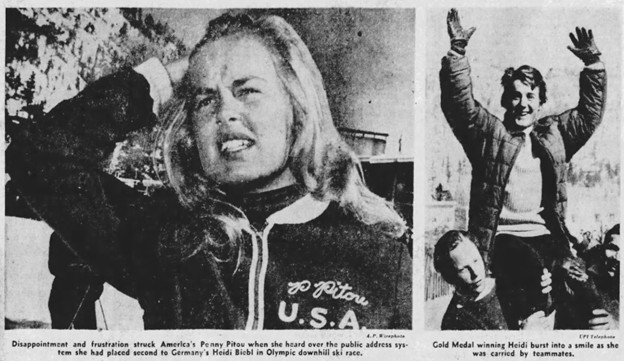
- Heidi Biebl, a 19‑year‑old German factory worker, stunned the field by winning the women’s downhill, the marquee Alpine event of the day.
- Helga Haase, a 26‑year‑old German bookkeeper and mother, captured the 500‑meter speed skating title.
- Marija Gusakova, a 29‑year‑old Soviet dressmaker, dominated the 10‑kilometer cross‑country race at McKinney Creek.
Each victory reflected a different facet of European excellence—technical precision, raw speed, and endurance.
American Hopes Rise and Fall
For the United States, Day 3 was a mix of heartbreak and resilience.
Penny Pitou’s Silver
The U.S. had entered the women’s downhill with unusually high expectations. Penny Pitou, the charismatic skier from New Hampshire, delivered a strong run and briefly held the lead with a time of 1:38.6. But Biebl’s faster descent—1:37.6—pushed Pitou into silver.
The disappointment deepened when Betsy Snite, another top American contender, fell early in her run. Ski Patrol removed her skis, and she walked down the course in tears—one of the most emotional moments of the Games’ early days.
Other American skiers struggled as well:
- Joan Hannah finished 21st
- Linda Meyers, after a fall on the lower slopes, placed 33rd
What had been billed as a potential U.S. sweep became a sobering reminder of the unpredictability of Alpine racing.
A Bright Spot in Figure Skating
The day’s most encouraging American performance came from Carol Heiss, the reigning world champion. In the opening phase of the women’s figure skating competition—the compulsory figures—Heiss built a commanding lead. Though medals would not be awarded until the free skate on Tuesday, her dominance offered reassurance that the U.S. would not leave Day 3 empty‑handed.
Barbara Ann Roles, another rising American star, also positioned herself well with a strong third‑place standing.
Jeanne Ashworth’s Surprise Medal
In speed skating, Jeanne Ashworth, a 22‑year‑old from Massachusetts, delivered an unexpected bronze in the 500 meters—one of the day’s most uplifting results for the U.S. team.
Hockey Brings High Scores and High Tension
While women’s events dominated the headlines, men’s hockey provided its own drama:
- Canada routed Japan 19–1, a lopsided result that contrasted sharply with their rougher play the previous night against Sweden.
- The Soviet Union defeated Finland 8–4, continuing their march toward another medal.
- Czechoslovakia overwhelmed Australia 18–1 in the late game.
Sweden formally protested Canada’s physical style of play, adding an early layer of controversy to the hockey tournament.
A Teenager’s Triumph and a Day of Contrasts
One of the most striking stories of the day belonged to Heidi Biebl, the teenage downhill champion. Despite reaching speeds of nearly 70 mph on KT‑22, she initially believed her run was too slow and stormed away from the finish area. Only later did she learn she had won gold.
Her victory, combined with Haase’s and Gusakova’s, created a narrative of working‑class European women rising to Olympic glory—factory workers, bookkeepers, and dressmakers standing atop the podium.
Courtesy of The San Francisco Chronicle February 21, 1960 via Newspapers.com
A Near-Perfect Start in Blyth Arena
The chilled air inside Blyth Arena set the stage for the first two compulsory figures, and Heiss delivered patterns so clean and controlled that the nine international judges awarded her unanimous first-place marks. Her early dominance reflected both her technical mastery and her experience—already a world champion and a bronze medalist from the 1956 Games.
The scoring system of the era placed enormous weight on compulsory figures, and Heiss’s total of 265.8 points gave her a commanding advantage. To lose the gold, she would have needed a major mistake or an unforeseen mishap in the remaining figures or the free skate.
Behind her, the European champion Sjoukje Dijkstra of the Netherlands emerged as her closest challenger. Dijkstra’s elegant skating and striking red costume drew strong applause, and her score of 244.5 kept her within reach, though still far behind the American leader.
Rising American Depth
The United States also found encouragement in the performance of Barbara Ann Roles, who placed third with 246.9 points. Roles, not yet 20 years old, had been viewed as a promising contender, and her strong start reinforced the depth of the American women’s figure skating program.
Other notable placements included:
- Loes Haanappel of the Netherlands
- Jana Mrazkova of Czechoslovakia
- Regine Heitzer of Austria
- Junko Ueno of Japan
Their presence in the top tier reflected the increasingly global nature of women’s figure skating by 1960, with talent emerging from across Europe and Asia.
The Broader Context of Day 3
Heiss’s performance came on a day when women’s events dominated the Olympic schedule. Downhill skiing, speed skating, and cross‑country had already produced dramatic results earlier in the morning, with European athletes sweeping the gold medals. Against that backdrop, Heiss’s commanding lead offered the United States a stabilizing moment—a reminder that American excellence in figure skating remained one of the nation’s strongest traditions.
The compulsory figures would continue through Sunday and Monday, with the free skate scheduled for Tuesday. But by the end of Day 3, the narrative was already taking shape: Carol Heiss was skating not just for a medal, but for a place in Olympic history.
A Silver Medal and a Crossroads
Pitou’s second‑place finish behind Germany’s Heidi Biebl had been one of the bright spots for the American team on a day otherwise dominated by European victories. Yet the medal seemed to bring her not triumph, but clarity. At 21, she spoke openly about the pressures of elite skiing and the desire to reclaim a more ordinary future.
She described the moment with a candor rarely heard from Olympic athletes of the era. “You get 21 and you’re too old,” she said, reflecting on the short competitive lifespan of women’s Alpine racers. She spoke of wanting to return to Middlebury College after a three‑year break, to think about “kids and money and such things,” and to stop living at the razor’s edge of competitive expectation.
Her comments revealed the emotional cost of the Olympic buildup. “You build yourself up to this peak, you crash, and you want to quit right now,” she admitted. The silver medal, in her mind, gave her permission to step away.
A Personal Life Waiting Beyond the Slopes
Pitou also hinted at another pull: her relationship with Austrian skier Egon Zimmermann, whom she affectionately described as “a real boy type.” Their romance had become one of the more charming subplots of the Games, and her desire to return to school and to a more grounded life reflected the tension many athletes felt between personal aspirations and the demands of international sport.
Her remark about losing by a single second—“A second can be forever”—captured both the heartbreak of competition and the thin margins that defined Olympic Alpine racing.
Jeanne Ashworth’s Quiet Triumph
The day also brought a more understated but deeply meaningful American success. Jeanne Ashworth, the 22‑year‑old speed skater from Massachusetts, earned a bronze medal in the women’s 500 meters. Her goal had been simple and personal: “I just wanted to beat a Russian.” She succeeded, finishing ahead of Tamara Rylova and Klara Guseva—two of the Soviet Union’s strongest sprinters.
Ashworth’s medal was a breakthrough moment for U.S. women’s speed skating, a discipline long dominated by European and Soviet athletes. Her performance added a note of resilience to a day when American hopes had been repeatedly tested.
Courtesy of The San Francisco Chronicle February 21, 1960 via Newspapers.com