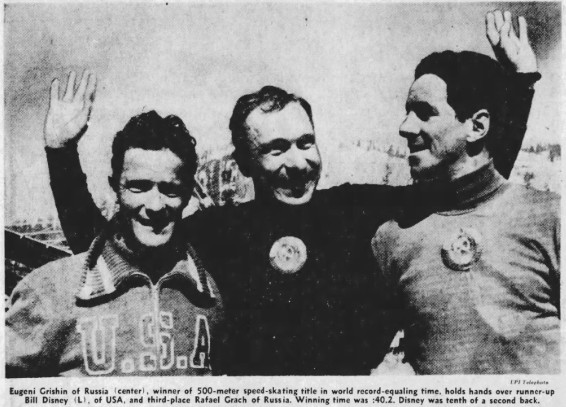
Courtesy of The San Francisco Chronicle February 25, 1960 via Newspapers.com
Russia Extends Its Command With a World‑Record Performance
The headline moment of the day came in the 500‑meter speed skating, where Evgéni Grishin, a Red Army lieutenant, delivered a blistering run that equaled his own world record of 40.2 seconds. His victory marked the Soviet Union’s fifth gold medal of the Games and added another 16 points to their already commanding lead in the unofficial standings.
American skater Bill Disney, a 27‑year‑old rug cleaner from California, came heartbreakingly close to an upset. His time of 40.3 seconds set a new U.S. record and would have won gold in any previous Olympics. But Grishin’s final‑turn recovery—after a dangerous skid—preserved the Soviet victory by a mere one‑tenth of a second.
The bronze also went to the USSR, with Rafael Grachev finishing in 40.4.
Disney’s silver was a proud moment for the U.S., but it also underscored the razor‑thin margins separating American breakthroughs from Soviet supremacy.
Austria Rebounds in the Men’s Slalom
After a disappointing start to the Alpine program, Austria reclaimed some of its traditional prestige. Ernst Hinterseer, a farmer from Kitzbühel, won the men’s slalom with a combined time of 2:08.9, mastering the twisting KT‑22 course with fluid, swivel‑hip precision.
His victory was especially meaningful given Austria’s earlier struggles in the downhill and giant slalom. The nation added a silver as well, with Mathias Leitner finishing second. France’s Charles Bozon earned bronze.
Germany’s Willy Bogner, who led after the first run, fell twice on his second descent and failed to finish—one of the day’s most dramatic reversals.
A Tight Race in Men’s Figure Skating
The opening compulsory figures in the men’s figure skating set the stage for a dramatic showdown. Czechoslovakia’s Karol Divín and France’s Alain Giletti finished ahead of American favorite David Jenkins, who placed third after three figures.
But the standings remained fluid. The free skate—where Jenkins, Tim Brown, and Bob Brewer excelled—was still to come. The Americans were widely expected to surge once the competition shifted from precision tracing to athletic artistry.
Jenkins, the younger brother of 1956 Olympic champion Hayes Jenkins, admitted he felt “a bit shaky,” but his technical strength and experience kept him firmly in medal contention.
The Soviet Lead Becomes Nearly Insurmountable
With Grishin’s gold and Grachev’s bronze, the Soviet Union pushed its unofficial point total to 120, far ahead of:
- Germany – 52.5
- United States – 44
Seventeen of the 28 gold medals had been awarded, and the Soviet advantage was so large that only a collapse of historic proportions could have altered the outcome.
The USSR’s success reflected the depth of its winter sports program—speed skating, cross‑country skiing, biathlon, and Nordic events all fed into a machine‑like accumulation of points.
A Day of High Stakes and Rising Tension
Day 7 captured the shifting dynamics of the Games:
- Soviet athletes continued to dominate the ice.
- Austria clawed back Alpine credibility.
- American skaters positioned themselves for a potential comeback in the free skate.
- Crowds swelled, with more than 18,700 spectators attending—pushing overall attendance past 156,000.
The Games were entering their final stretch, and the pressure on American athletes—especially in figure skating and hockey—was intensifying.
Ski Theft Emerges as an Unexpected Olympic Subplot
With tens of thousands of visitors pouring into Squaw Valley, the once‑informal etiquette of ski culture began to strain. According to locals and instructors, an organized pattern of ski thefts had taken hold. Skis left upright in the snow—standard practice for decades—were disappearing in broad daylight.
Veteran skiers lamented the loss of the old mountain camaraderie. One recalled that “in the old days you never worried about your skis… there were only a few of us in love with this sport.” But the Olympics had brought crowds of unprecedented size, and with them, new temptations. Modern skis cost around $100—a significant sum in 1960—and the anonymity of the bustling valley made theft easier.
Instructors noted that even engraved names and serial numbers offered little protection. A thief could simply claim confusion: “I thought they were mine—I had a pair just like them.” The sheer volume of nearly identical skis made such excuses difficult to disprove.
Some locals proposed creative solutions. One San Franciscan suggested reviving a “Wild West” approach: hitching posts with ski locks, a humorous but telling sign of how the Olympics were forcing the sport to adapt to a new scale.
Cultural Clashes in the Olympic Village
The theft problem was only one sign of Squaw Valley’s growing pains. The Games also exposed cultural gaps—most notably in the dining halls. Members of the Japanese delegation complained that American cooks were preparing traditional dishes incorrectly, especially sashimi and rice, which they felt were being oversalted.
In response, restaurateur George Tsukagawa of Mountain View stepped in, sending chefs to help prepare authentic meals and eventually arriving himself to supervise. The episode highlighted the challenges of hosting a truly international event in a remote mountain valley still learning how to accommodate global tastes.
The Long-Term View From Nevada
While some issues caused frustration, others inspired optimism. Reno casino operator Bernie Einstoss offered a pragmatic assessment: the Olympics hadn’t boosted gaming revenue in the short term—visitors were too exhausted from early buses and mountain treks to gamble—but the long-term benefits were clear.
The Games had accelerated improvements to Highway 40 and introduced millions of Americans to the Sierra Nevada. For businesses across the region, the exposure promised dividends for decades.
Courtesy of The San Francisco Chronicle February 25, 1960 via Newspapers.com Article by Art Rosenbaum
The Interpreter Who Became a Star
As the Soviet Union collected medal after medal—five golds by February 24—Vislousov appeared again and again before the international press to translate for victorious athletes. He was tall, impeccably dressed in the blue‑gray greatcoat of the Soviet delegation, and unfailingly composed. Reporters joked that he was becoming more recognizable than many of the medalists themselves.
He wasn’t even an official interpreter. His actual role was chief of transport for the Soviet team. But the delegation preferred that one of their own handle the delicate task of translating athletes’ remarks, and Vislousov’s polished English made him the natural choice.
With each Soviet medal, he returned to the press table—so often that journalists began to greet him like a recurring character in a long‑running play. Some teased that they should bake him a cake when the Games ended.
A Tower of Babel in the Mountains
The reliance on Vislousov created a quiet rivalry among the official interpreters, especially those eager to demonstrate their fluency in Russian. Among them was Victor Tchelistcheff Jr., a San Francisco engineer and assistant director of interpreters, who spoke multiple Slavic and Germanic languages. Yet he rarely got the chance to step in. The Soviets trusted their own man, and Vislousov’s presence became a daily reminder of the USSR’s growing influence at Squaw Valley.
The Games themselves were a linguistic whirlwind. Forty‑five interpreters covered 124 languages, and the press corps—American and foreign—struggled to keep up. Many joked they would need a refresher course in English by the time they returned home.
Life Inside the Olympic Village Post Office
Another unexpected window into the international character of the Games came from the tiny Olympic Village post office. Postmistress Hannah Cornoa, fluent in French and German, described a mailroom bursting with letters—30,000 to 38,000 pieces a day, with as many as 100,000 expected during the final weekend.
Patterns emerged:
- Italians and Germans wrote the most letters and received the most in return.
- The French and Poles followed closely.
- The Russians, despite their large team, wrote and received very little mail.
- Norwegians and Swedes were the easiest customers, thanks to widespread English education.
- The press, domestic and foreign, were the most challenging—no surprise to anyone working behind the counter.
The post office became a microcosm of the Games: crowded, multilingual, and buzzing with the energy of thousands of athletes, officials, and visitors.
Fashion, Fur, and the Biathlon Effect
Squaw Valley also became a showcase for some of the era’s more eccentric winter fashions. Reporters noted the explosion of oversized furry hats, so large and shaggy they made Senator Estes Kefauver’s famous coonskin cap look modest. Some joked that visitors should leave their hunting rifles at home—anyone wearing such a hat might be mistaken for wildlife.
Fortunately, the biathlon—where rifles were actually used—was held 17 miles away at McKinney Creek. But the humor underscored the cultural mash‑up of the Games: elite sport, international diplomacy, and a touch of frontier absurdity.
Courtesy of The San Francisco Chronicle February 25, 1960 via Newspapers.com Article by Will Connolly