Courtesy of The San Francisco Chronicle February 26, 1960 via Newspapers.com
Russia Extends Its Lead With a Birthday Victory
The Soviet Union’s sixth gold medal came from Viktor Kosichkin, a 22‑year‑old electrician from Moscow who celebrated his birthday by conquering the brutal conditions at the 5,000‑meter speed skating event. Battling gusts up to 30 miles per hour, Kosichkin delivered the race of his life, finishing in 7:51.3—an astonishing 18 seconds faster than he had ever skated before.
His victory widened the Soviet Union’s already commanding lead in the unofficial team standings. With 120 points, the USSR was pulling away from Germany and the United States, and with many of their strongest events still ahead, the outcome of the overall competition was becoming increasingly clear.
Norway’s Knut Johannesen briefly held the lead with an 8:00.8, but Kosichkin—paired with Dutch skater Jan Pesman—surged past him. Pesman finished third, completing a podium dominated by northern European endurance specialists.
The American contingent struggled in the wind:
- Arnold Uhrlass placed 14th
- Richard Hunt finished 17th
- Floyd Bedbury placed 30th
It was a tough day for U.S. speed skating, which had hoped to build on Bill Disney’s silver medal from the 500 meters.
Finland Breaks Through in the Ski Relay
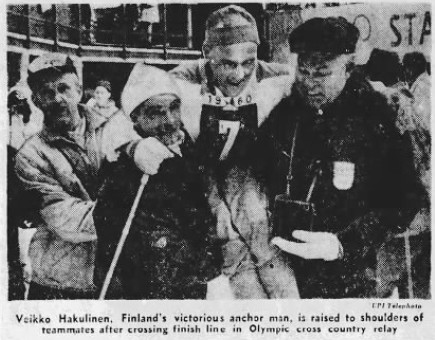
The day’s other major endurance event, the 40‑kilometer cross‑country relay, produced Finland’s first gold medal of the Games. In a dramatic final lap, Veikko Hakulinen, a forest ranger known for his stamina, erased a 20‑second deficit to overtake Norway’s Haakon Brusveen just two kilometers from the finish.
Finland’s victory—by a mere tenth of a second—was one of the closest relay finishes in Olympic history. The Soviet Union took bronze, adding yet another medal to its growing tally. The United States finished 11th and last, underscoring the gap between American and European depth in Nordic skiing.
David Jenkins Climbs to Second in Men’s Figure Skating
While the United States failed to score points in the day’s endurance events, it found hope on the ice. David Jenkins, the younger brother of 1956 Olympic champion Hayes Jenkins, moved from third to second place after completing all five compulsory figures in the men’s figure‑skating competition.
Jenkins trailed only Karel Divín of Czechoslovakia, who led with 797.7 points to Jenkins’ 775.2. France’s Alain Giletti, the early leader, slipped to third.
The compulsory figures—worth 60 percent of the total score—set the stage for the free skate, where Jenkins was widely regarded as the world’s best. Even Divín acknowledged the American’s strength, saying, “I think Dave will be first, but I would be happy with second. It would make me the top European.”
The standings entering the free skate:
- Karel Divín (Czechoslovakia) – 797.7
- David Jenkins (USA) – 775.2
- Alain Giletti (France) – 762.7
- Don Jackson (Canada) – 751.4
- Tim Brown (USA) – 749.9
Bob Brewer of the U.S. slipped from sixth to seventh, but the American team remained well‑positioned for a strong showing in the final phase.
A Day Defined by Weather and Endurance
The blustery conditions shaped the day’s results:
- The wind favored larger, more powerful skaters like Kosichkin and Johannesen.
- Smaller athletes, including Japan’s Takeo Mizoo, struggled. Mizoo summed it up memorably: “You can throw a rock into the wind, but you can’t throw a feather.”
- Snow flurries at McKinney Creek kept crowds small, but the relay still produced one of the most dramatic finishes of the Games.
Courtesy of The San Francisco Chronicle February 26, 1960 via Newspapers.com
A Breakthrough Win in a Packed Arena
Before a standing‑room‑only crowd of 8,500, the Americans outskated, outworked, and ultimately outlasted a Canadian team long considered one of the sport’s global powerhouses. The atmosphere inside Blyth Arena was electric, with the pro‑U.S. crowd roaring at every line change and erupting when the Americans found the net.
The victory vaulted the United States into first place in the final round‑robin standings, ahead of both Canada and the defending Olympic champions from the Soviet Union. With a perfect 3–0 record, the Americans suddenly found themselves in control of their own destiny.
John McCartan’s Masterclass in Goal
The heart of the upset was goaltender John McCartan, a 24‑year‑old former University of Minnesota standout whose performance became one of the defining individual efforts of the 1960 hockey tournament. Facing 39 shots from a relentless Canadian offense, McCartan turned aside nearly everything—catching, deflecting, kicking away, and even smothering pucks in a display of athletic improvisation.
Canada’s only goal came late in the third period, when Jim Connelly redirected a shot that deflected off McCartan’s stick. Until that moment, the Canadians had been held scoreless despite wave after wave of pressure.
McCartan’s poise under fire became a symbol of the U.S. team’s resilience and a preview of the heroics that would define their run through the final weekend.
Cleary and Johnson Provide the Offense
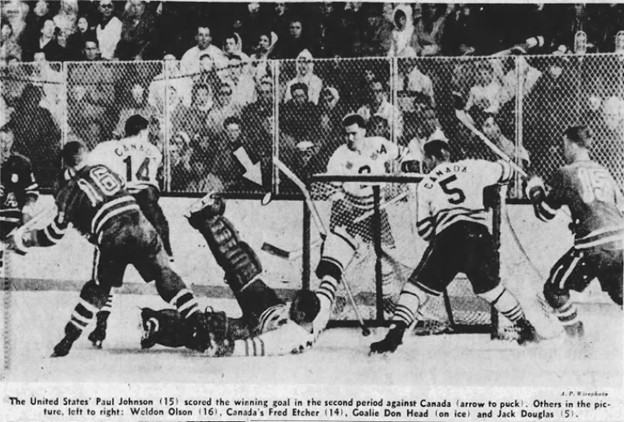
The Americans capitalized on their chances with precision. Midway through the first period, Bob Cleary, a Boston insurance salesman playing alongside his brother Bill, scored the opening goal. In the second period, Paul Johnson, a former University of Minnesota star from St. Paul, added the second tally.
Those two goals proved enough, thanks to McCartan’s brilliance and a disciplined defensive effort that frustrated Canada’s normally potent attack.
A Physical, Tense Contest
The game was marked by intensity and frequent flashes of temper. Early in the first period, U.S. defenseman Bob Owen tangled with Canada’s Maurice Benoit—nicknamed the “Bad Man” of the Games—behind the American net. Benoit later drew a penalty for interference, but the U.S. failed to convert on the power play.
The physicality underscored the stakes: both teams understood that the outcome would shape the medal race.
Shifting Standings and Rising Stakes
Elsewhere in the tournament, the Soviet Union defeated Germany 7–1, moving into second place behind the Americans. Czechoslovakia beat Sweden 3–1 to climb into fourth. The standings tightened, but the U.S. remained in control.
The Americans now faced a decisive showdown with the Soviets on Saturday—a game that many believed would determine the gold medal. After that, only Czechoslovakia remained on the U.S. schedule.
A Region New to Hockey Finds Its Sport
Blyth Arena, built to seat 8,500, overflowed with more than 9,000 spectators for the U.S.–Canada showdown. Many were Northern Californians who had never seen high‑level hockey before. They skipped dinner, paid premium prices, and packed the aisles to witness a sport that had rarely taken root on the West Coast.
Earlier attempts to introduce professional hockey in San Francisco—first on Sutter Street before the war, then at Winterland afterward—had fizzled. The quality of play had been modest, and the public stayed away. But the Olympic tournament offered something entirely different: fast, skilled, international hockey played at the highest level. For many spectators, it was a revelation.
The excitement suggested that the Bay Area might finally be ready to embrace the sport. Observers noted that arenas such as the Cow Palace could easily be adapted for ice, just as Madison Square Garden alternated between hockey, basketball, and horse shows. The Olympics had shown that the appetite was there—what remained was the infrastructure.
The U.S. Team Captures Local Imagination
The timing of the hockey surge was ideal. With most skiing and skating events winding down, hockey had become the centerpiece of the final Olympic days. The United States entered the weekend undefeated and untied, preparing for a crucial matchup with the Soviet Union on Saturday afternoon. The Soviets, wearing their distinctive CCCP sweaters, had one blemish—a tie with Sweden—but remained a formidable threat.
The American team itself had become a compelling story. The Cleary brothers from Harvard, known more for finesse than physicality, were proving themselves as tough as any players in the tournament. Minnesota’s John Mayasich, a standout since childhood, anchored the offense. And the team’s manager, Jim Claypool of Duluth, offered a memorable comparison: Soviet hockey, he said, resembled chess—precise, calculated, and disciplined—while the Americans relied on power and momentum.
The contrast added intrigue to the upcoming U.S.–USSR showdown, a game that would help define the tournament and, as history would show, the future of American hockey.
A Family Affair on the Slopes
Day 9 also highlighted the remarkable presence of the Leduc family of France. Eleven siblings made up the clan, and three of the daughters competed in the women’s slalom. Anne finished fourth, with Anne‑Marie and Marguerite placing 19th and 21st. Their collective appearance became one of the charming human-interest stories of the Games.
The slalom itself was won by Canada’s Anne Heggtveit, whose thick blonde hair and fearless skiing drew comparisons to Brigitte Bardot. Betsy Snite of the United States finished second, continuing a pattern of near‑misses for the American women’s Alpine team.
Cultural Exchange and Celebration
The Japanese delegation prepared to contribute one of the weekend’s most anticipated spectacles: a fireworks display unlike anything most Americans had ever seen. Their pyrotechnics, featuring multi‑stage roman candles and elaborate aerial patterns, promised to outshine traditional Fourth of July shows. A rehearsal earlier in the week had already dazzled onlookers.