Courtesy of The San Francisco Chronicle February 27, 1960 via Newspapers.com
Jenkins Completes a Family Legacy
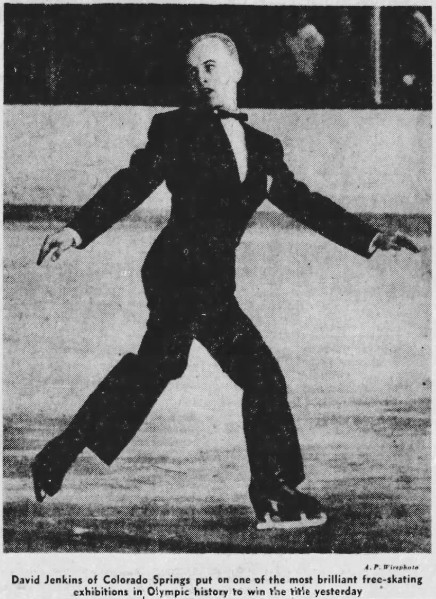
Jenkins entered the free‑skating phase trailing Czechoslovakia’s Karol Divín after the compulsory figures, but the free skate had always been his domain. In front of 8,000 spectators—including former Olympic champion Sonja Henie and newly crowned women’s champion Carol Heiss—he delivered a performance that blended athletic precision with theatrical flair.
His routine earned 10 ordinals and 1,440.2 points, enough to overtake Divín and secure the gold. Divín, gracious in defeat, applauded Jenkins from the boards and took silver with 1,414.3 points. Canada’s Don Jackson earned bronze.
The moment carried added resonance: Jenkins’s older brother, Hayes Alan Jenkins, had won the same title at Cortina in 1956. With Dave’s victory, the Olympic men’s figure‑skating crown remained in the family for a second consecutive Games.
One judge, Emil Skákala of Czechoslovakia, awarded Jenkins a perfect 6.0—the first given in any singles or pairs event at the 1960 Games. Seven other judges scored him at 5.9, just shy of perfection.
A Day of Multiple Gold Medals Across the Valley
Jenkins’s victory was one of four gold medals awarded on Day 9, each reflecting a different facet of the Games’ international character.
- Men’s 1,500‑meter speed skating produced the first gold‑medal tie of the Olympics. Russia’s Eugeni Grishin and Norway’s Roald Aas finished in identical times of 2:10.4, sharing the top podium spot. The tie eliminated the silver medal; Russia’s Boris Stenin took bronze.
- Women’s slalom was won by Canada’s Anne Heggtveit, whose aggressive second run secured her nation’s second gold medal. Her total time of 1:49.6 placed her comfortably ahead of the United States’ Betsy Snite.
- Women’s 15‑kilometer cross‑country relay went to Sweden, though the result was immediately protested by the Soviet Union after a collision involving Finnish and Swedish skiers. Officials planned to review color film in San Francisco before issuing a final ruling.
These results continued to shape the unofficial team standings, where the Soviet Union surged to 153.5 points, far ahead of the United States (61) and Germany (58.5).
Heartbreak for Penny Pitou
The women’s slalom brought another difficult moment for American skiing star Penny Pitou. After two silver medals earlier in the Games, she needed only a top‑ten finish to secure the world Alpine combined title. Instead, she fell twice and finished 33rd.
Her reaction captured both disappointment and perspective: “It was nice to be a world champion for a minute or so anyhow. If I had stood up I would have been the champion. I couldn’t stand up. Oh well—you can’t win ’em all.”
Her teammate Beverly Anderson placed 26th, while Renie Cox finished ninth.
A Rising Crowd and a Growing Sense of Finale
Attendance continued to swell as the Games approached their final weekend. More than 17,000 spectators filled the valley on Day 9, pushing total attendance to nearly 189,000. The atmosphere reflected both the excitement of the closing days and the anticipation of major events still to come—especially the decisive hockey match between the United States and the Soviet Union.