Round 1 – April 7th
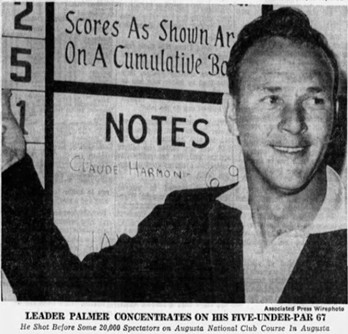
Palmer Blazes Opening‑Round 67 to Lead Masters Field
Venturi Soars With 31, Then Crashes With 42 on Tumultuous Back Nine
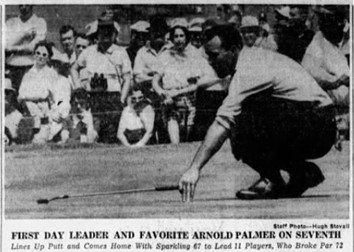
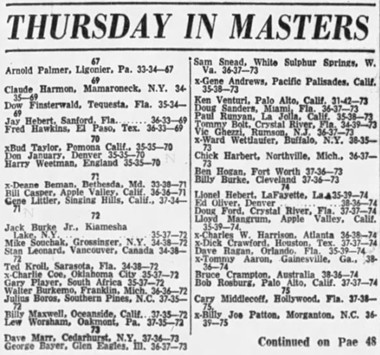
AUGUSTA, Ga., April 7 — Arnold Palmer, the fearless Pennsylvanian who treats Augusta’s legends and jinxes with equal disregard, stormed to the front of the Masters Tournament Thursday with a brilliant five‑under‑par 67, seizing the first‑round lead before a sun‑splashed gallery of 20,000.
The experts said Palmer was the man to beat — and the 1958 champion wasted no time proving them right. His 67 was the best opening‑day score since Ken Venturi’s 66 in 1956, and it set the tone for one of the wildest first rounds in recent Masters memory. Eleven players broke par on the 6,850‑yard Augusta National course, which took a rare pounding from the field.
Four players — Fred Hawkins, Claude Harmon, Dow Finsterwald, and Jay Hebert — posted 69s to share second place.
Palmer’s Eagle Sparks Front‑Nine 33
Palmer’s round was a model of controlled aggression. He opened with back‑to‑back birdies inside two feet, bogeyed the fifth, then electrified the crowd with a spectacular eagle at the par‑five eighth, blasting from a greenside trap and watching the ball trickle 20 feet into the cup. He turned in 33.
His only stumble on the inward half came at the 11th, where he three‑putted for bogey. But he steadied himself, survived the treacherous 12th — the hole that cost him the title last year — and birdied both the 13th and 15th. The finishing touch was an 18‑foot birdie putt at the 18th, drawing a roar from the gallery.
“It’s the best round I’ve ever shot here,” Palmer said afterward. “I was never in any serious trouble, never out of the fairway all day.”
Venturi’s Collapse Stuns Gallery
The day’s most dramatic story belonged to Ken Venturi, who matched a Masters record with a blazing 31 on the front nine, only to unravel with a disastrous 42 coming home. Venturi eagled the second, birdied the ninth, and stood five under par at the turn — but five bogeys and a double bogey on the back nine left him with a 73.
The Californian, who has suffered more than one Augusta heartbreak, walked off without a word.
Amateurs Shine; Giants Struggle
Three players — amateur Dr. Bud Taylor, Don January, and Britain’s Harry Weetman — shot 70 to tie for sixth. Behind them came Bill Casper, Gene Littler, and amateur Deane Beman with 71s.
Ten players, including Mike Souchak, posted even‑par 72s.
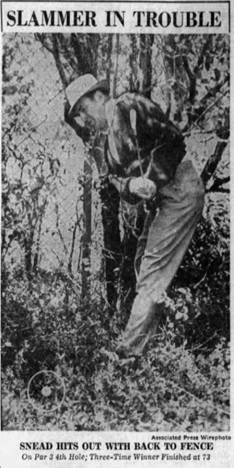
Two of golf’s enduring titans, Sam Snead and Ben Hogan, settled for 73s, leaving them six shots behind Palmer.
Course Plays Easier, Pins Tougher
Players agreed the course played easier than in years past, though several complained of “impossible pin placements.” Palmer suggested the officials tightened the pins to offset the softer conditions elsewhere.
Among the amateurs, Georgians Charlie Harrison and Tommy Aaron turned in fine 74s, outscoring national amateur champion Jack Nicklaus and veteran Billy Joe Patton.
Tournament Continues Through Sunday
With three rounds still ahead, the Masters remains wide open — but on this warm April afternoon, the spotlight belonged entirely to Palmer, who strode off the course looking every inch the man to beat.
“I feel good about my chances,” he said. “A round like this is the one you need somewhere during the week. I’m glad I got mine today.”
 |  |
Courtesy of The Atlanta Constitution April 8, 1960 via Newspapers.com
Round 2 – April 8th
Palmer Hangs Onto Masters Lead as Rules Rhubarb Rocks Augusta
Finsterwald Hit With 2‑Stroke Penalty; Hogan Charges With Vintage 68
AUGUSTA, Ga., April 8 — A day of rules, rulings, and rhubarbs turned the Masters Tournament into a mathematical puzzle Friday, but when the dust finally settled over the rolling hills of Augusta National, Arnold Palmer still held the lead — just barely.
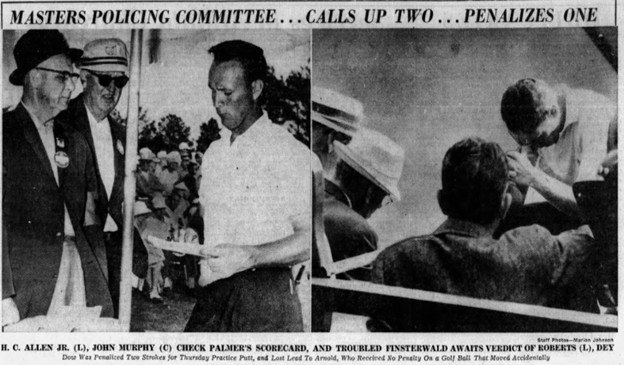
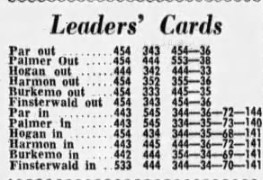
Palmer, who opened with a brilliant 67 on Thursday, struggled to a 73 in the second round for a 36‑hole total of 140, four under par and one stroke ahead of a tightly packed field. But the big story of the day was not Palmer’s uneven play — it was the stunning two‑stroke penalty that knocked Dow Finsterwald out of the lead and nearly out of the tournament.
Finsterwald, who believed he had taken command with a sparkling 70, learned after finishing his round that he had violated a rule the day before, practicing a putt on the fringe of the fifth green. The penalty changed his opening 69 to a 71 and dropped him into a four‑way tie at 141.
“It’s the best I could hope for,” Finsterwald said. “I clearly violated the rules.”
Hogan Roars Back With Best Round of the Day
Sharing second place with Finsterwald are:
- Ben Hogan, who turned back the clock with a masterful 68,
- Claude Harmon, the 1948 champion, who posted a steady 72,
- Walter Burkemo, who fired a 69.
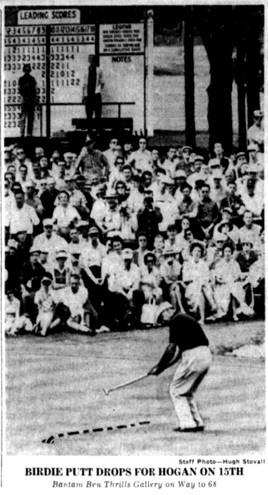
Hogan’s round was vintage Fort Worth steel. He birdied the second, sixth, and eighth for a front‑nine 33, stumbled with bogeys at 11 and 12, then rallied with three straight birdies on 13, 14, and 15 — the last on an 18‑foot putt.
Venturi Recovers; Casper, January Stay Close
Three players sit just two strokes back at 142:
- Ken Venturi, who rebounded from Thursday’s disastrous 42 on the back nine with a fine 69,
- Don January, the quiet pro from Denver,
- Billy Casper, the U.S. Open champion, who carded a 71.
At 143, only three behind, are Billy Maxwell, amateur Deane Beman, Julius Boros, and South Africa’s Gary Player, all with 71s or 72s.
In all, 16 players are within four shots of Palmer — making this one of the most wide‑open Masters in years.
Palmer Survives Scare Over Moving Ball
Palmer himself had to sweat out a possible penalty. On the 15th hole, his second shot settled behind a trap, and as he examined the lie, the ball moved. Palmer immediately reported it. After review, officials ruled he had not caused the movement and assessed no penalty.
It was a fortunate break for the Pennsylvanian, who needed every stroke on a day when his game lacked Thursday’s precision. He bogeyed the fourth, sixth, and seventh, salvaged a 38 on the front with a 10‑foot birdie at the ninth, and steadied himself with pars on every back‑nine hole except the 17th, where a deft chip set up a birdie.
Big Names Miss the Cut
The cut fell at 150, and 45 players advanced. Among the casualties:
- Cary Middlecoff, 1955 champion (151)
- Jimmy Demaret, three‑time winner (151)
- Byron Nelson (152)
- Gene Littler (153)
- Ed Furgol (153)
Atlanta amateur Charlie Harrison, who shot 74 Thursday, ballooned to 79 and missed with 153. Fellow Georgian Tommy Aaron survived with 149.
A Wild Day Ends With a Tight Race Ahead
With two rounds left, Palmer leads — but only by a whisker. Finsterwald’s penalty, Hogan’s resurgence, and Venturi’s revival have turned the Masters into a free‑for‑all.
As one veteran observer put it, “This thing is anybody’s show now.”
The big battle resumes Saturday morning.
 |  |
Courtesy of The Atlanta Constitution April 9, 1960 via Newspapers.com
Round 3 – April 9th
Palmer Clings to One‑Stroke Masters Lead as Winds Batter Field
Hogan, Venturi, Casper, Boros, Finsterwald Form Tight Pack One Shot Back
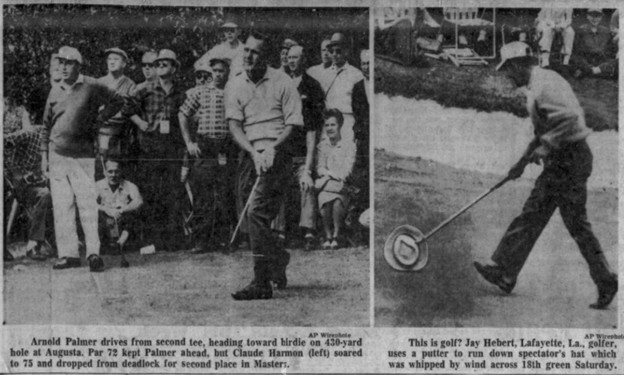
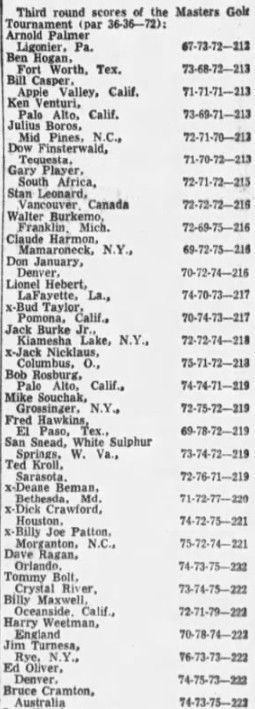
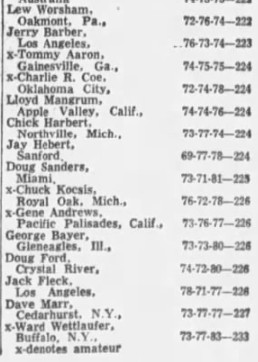
AUGUSTA, Ga., April 9 — Arnold Palmer, fighting a biting wind and a balky putter, held grimly to his Masters lead Saturday, finishing the third round with an even‑par 72 for a 54‑hole total of 212. His margin is still a single stroke — but the challengers have multiplied, and the Masters now stands on the brink of one of the wildest finishes in its 24‑year history.
Five men — Ben Hogan, Billy Casper, Dow Finsterwald, Julius Boros, and Ken Venturi — are tied one shot behind at 213, forming the most formidable chasing pack Palmer has faced all week.
The crowd of 40,000 that swarmed Augusta National saw Palmer blaze out in 34, then falter coming home with three bogeys and only one birdie. He reached the 18th green looking uneasy, but steadied himself for a par that kept him atop the board for the third straight day.
“I putted like Joe Schmokes,” Palmer said afterward, shaking his head. A putting lesson Friday night had done little good — he three‑putted the eighth and 11th and missed several makeable chances.
Hogan Calls Course ‘Easy’ Despite Wind
At 47, Ben Hogan continues to defy time. The two‑time Masters champion posted a steady 72 and afterward declared, to the surprise of many, that the 6,850‑yard Augusta National “played easy.”
“Only the pin positions made it tougher than yesterday,” Hogan said. Yet even he admitted to missing three putts inside two and a half feet.
Casper and Venturi each shot 71, while Finsterwald matched par. Boros, the only man to dent par in the blustery conditions, turned in the day’s best round — a polished 70 featuring long birdie putts of 40 feet at the fourth and 20 feet at the tenth.
Palmer Survives Rough Patches
Palmer’s biggest trouble came at the 13th, the 475‑yard dogleg guarded by Rae’s Creek. Going for the green in two, he pulled his shot into the water, took a drop, and then missed a four‑footer for bogey, settling for six. He also bogeyed the 17th after overshooting the green and chipping too strongly.
His lone long putt of the day was a downhill 15‑footer for birdie at the seventh.
Still, Palmer has led from the start with rounds of 67‑73‑72, and remains the man to catch.
Venturi, Finsterwald, Boros All Miss Chances to Tie
Venturi, still chasing the Masters title he nearly won in 1956, lost his chance to tie for the lead at the 15th. Playing safely short of the pond, he pitched poorly, the ball rolling back toward the water. After chipping again, he missed a three‑footer.
Finsterwald, still feeling the sting of Friday’s two‑stroke penalty for an unintentional rules violation, could also have shared the lead but settled for par.
Boros had his opportunity on the 18th, but a poor approach forced him to chip to five feet — and he missed the putt.
Player, Leonard, Burkemo, January, Harmon Still in the Hunt
Two strokes back at 215 is Gary Player, the young South African Open champion, who posted a 72. At 216 come Stan Leonard, Walter Burkemo, Don January, and Claude Harmon — all still within striking distance.
Last year, Art Wall came from six shots behind on Sunday to win with a closing 66. With the field so tightly packed, a similar charge could decide this year’s title.
Final Round Promises a Classic Finish
With Palmer clinging to a narrow lead and five major champions breathing down his neck, Augusta National is poised for a dramatic Sunday showdown.
As one veteran observer put it, “This one won’t be settled until the last putt drops.”
 |  |
Courtesy of The St. Petersburg Times April 10, 1960 via Newspapers.com
Final Round – April 10th
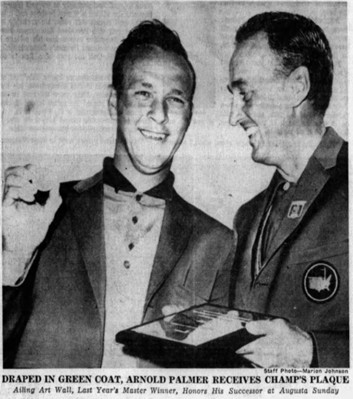
Palmer’s Daring Birdie Finish Wins Masters by One Stroke
Arnold Overhauls Venturi With Birds at 17 and 18; Claims Second Green Jacket
AUGUSTA, Ga., April 10 — Arnold Palmer, the cool‑nerved king of golf’s new generation, staged one of the greatest finishing flourishes in Masters history Sunday afternoon, firing birdies on the final two holes to snatch victory from the grasp of Ken Venturi and capture his second Masters title in three years.
With thousands roaring across the hills of Augusta National and millions more watching on television, Palmer rolled in a 25‑footer at the 17th and a six‑footer at the 18th to complete a closing 70 and finish with a 72‑hole total of 282, six under par.
Venturi, who had posted a brilliant 70 of his own and finished at 283, sat in the clubhouse believing the long‑coveted green jacket was finally his. But Palmer, two holes from defeat, summoned the same boldness that has made him the most electrifying figure in the game.
A Heart‑Stopping Finish
Palmer reached the 17th needing at least one birdie to tie and two to win. His second shot stopped 25 feet short. He studied the putt, stroked it firmly, and watched the ball curl into the cup. The gallery erupted as Palmer performed a jubilant hop — the famous “Palmer war dance.”
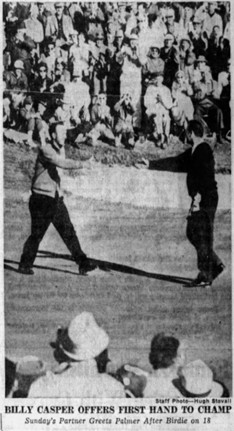
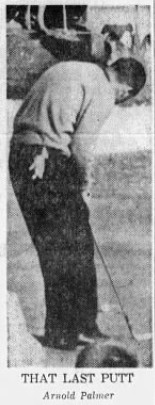
At the 18th, he refused to play for the tie. A booming tee shot left him a perfect angle, and his approach settled six feet from the hole. After asking photographers to halt their cameras, Palmer calmly stroked the putt home.
That was the end of Venturi’s hopes — and the coronation of Palmer as golf’s new “Mr. Golf.”
Venturi’s Latest Augusta Heartbreak
For Venturi, the slender Californian who has known more Masters misery than any player of his era, it was another cruel chapter. He had led much of the afternoon, going out in 33 and playing steady, controlled golf on the back nine.
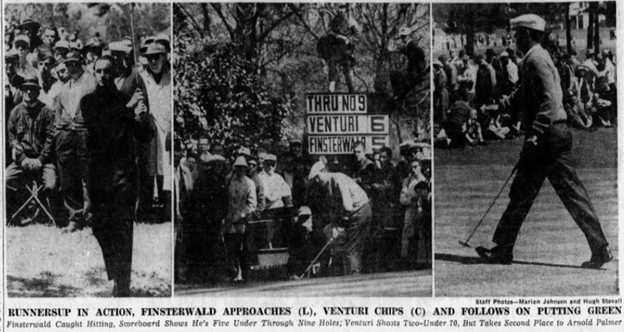
His only major slip came at the 11th, where he found water and took a penalty stroke. Otherwise, he was flawless, even producing a brilliant bunker recovery at the 16th that rolled to within four inches.
Venturi’s par at the 18th — after what he called “the biggest drive of my life” — seemed enough to win. But Palmer had other ideas.
Finsterwald Third After Missed Chances
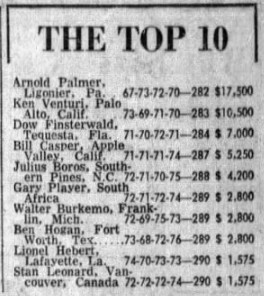
Dow Finsterwald, who battled Venturi head‑to‑head for much of the afternoon, lost his chance at the 11th with a bogey and finished third at 284 after a final‑round 71. His two‑stroke penalty from Friday’s rules infraction remained a bitter footnote.
Casper, Boros, Hogan Fade
Billy Casper, the U.S. Open champion, could not keep pace and closed with a 74 for 287, good for fourth. Julius Boros, who had been in the thick of the chase, slipped to a 75 and finished fifth at 288.
Three players tied for sixth at 289:
- Ben Hogan, who soared to a 76 after a promising start,
- Gary Player, the young South African star,
- Walter Burkemo, the former PGA champion.
Palmer Leads Wire‑to‑Wire
Palmer became the first man since Craig Wood in 1940 to lead after every round. His scores — 67‑73‑72‑70 — reflected both brilliance and grit. He missed short birdie chances early Sunday, bogeyed the third and fifth, and needed a birdie at the eighth to steady himself.
But when the pressure reached its peak, Palmer rose to meet it.
“I knew all the time what the situation was,” he said afterward. “Those scoreboards out there are mighty big.”
A Champion’s Payday
The victory was Palmer’s fifth of the year, raising his season earnings to $44,256, including the Masters’ record first prize of $17,500. Venturi earned $10,500, and Finsterwald $7,000.
A Masters for the Ages
In a tournament filled with shifting winds, tight leaderboards, and dramatic swings of fortune, Palmer’s closing charge will be remembered as one of Augusta’s greatest moments.
Two holes from defeat, he became a champion again.
 |  |
Courtesy of The Atlanta Constitution April 11, 1960 via Newspapers.com